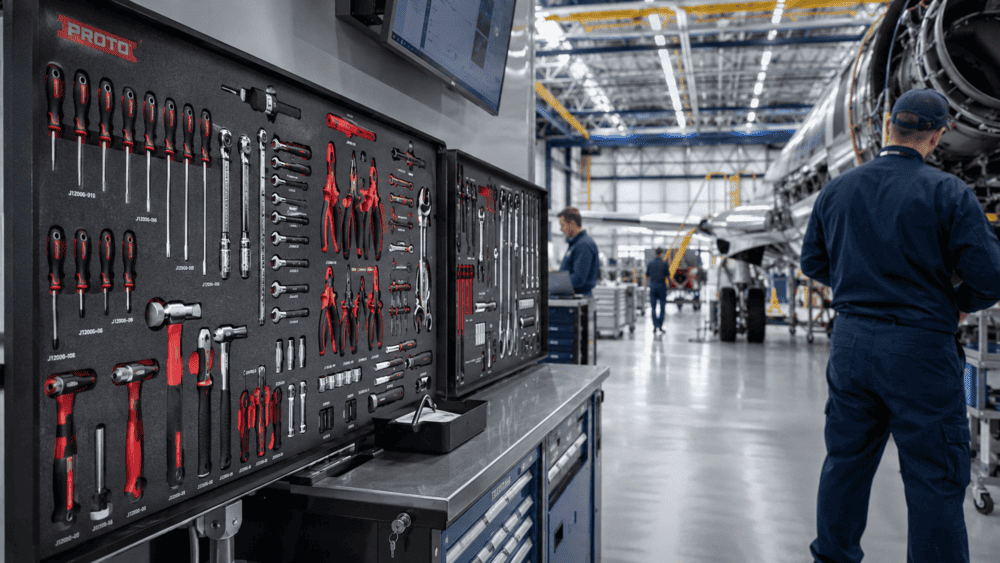
What Is Tool Control and Why Every Major Industry Is Adopting It in 2026
The Hidden Cost Most Factories Are Still Ignoring
Somewhere right now, a maintenance technician is spending twenty minutes searching for a torque wrench that should be on a shelf. An aircraft mechanic is completing a Foreign Object Debris (FOD) check that’s holding up a departure gate. A plant manager is explaining to an auditor why three calibrated instruments have no usage records. And a procurement officer is approving yet another emergency purchase order for tools that were never returned from the floor.
These are not edge cases. They are daily realities across manufacturing plants, aviation hangars, oil rigs, and automotive facilities around the world. Tool mismanagement quietly bleeds millions of dollars from industrial operations every year — not in dramatic accidents, but in accumulated minutes of lost time, unnecessary replacement costs, compliance gaps, and safety exposures that never quite make it into an incident report.
In 2026, with Industry 4.0 entering its operational maturity phase and regulatory pressure reaching new heights across sectors from aerospace to pharmaceuticals, industrial organizations are confronting a truth they can no longer defer: uncontrolled tools are a business risk. And tool control is the solution.
This guide explains exactly what tool control is, how it works at an operational level, why adoption is accelerating across industries globally, and what decision-makers need to understand before implementing a system in their own facilities.
What Is Tool Control — A Complete Definition
Tool control is the systematic process of managing, tracking, organizing, and maintaining accountability over tools within an industrial or operational environment. It encompasses everything from how tools are stored and issued to how their usage is recorded, calibration is monitored, and their return is verified after every task.
At its core, tool control answers three operational questions that every maintenance manager, plant supervisor, and quality officer needs to answer at any given moment: Where is each tool right now? Who has it? Is it in the condition it should be in?
Unlike basic tool organization — which might mean a labeled shelf or a locked cabinet — tool control is a structured system built around accountability, traceability, and process compliance. It may involve physical systems like shadow boards and foam cut-out inserts, digital platforms like barcode scanning or RFID-based check-out/check-in systems, or integrated software solutions that connect tool usage data with maintenance schedules, calibration tracking, and procurement systems.
The most comprehensive tool control implementations today combine all of these layers: a physical organization methodology that makes missing tools instantly visible, a digital tracking layer that creates a timestamped record of every tool movement, and a reporting layer that feeds into auditing, compliance, and operational analytics.
This is why tool control has evolved from a workshop housekeeping practice into a core operational infrastructure element — one that directly affects safety outcomes, regulatory compliance, asset utilization, and production efficiency.
Why Tool Control Is Becoming Non-Negotiable in 2026
The argument for tool control is not new. Aviation maintenance organizations have operated formal tool control programs for decades, driven by FAA and EASA regulations that treat a missing tool as a potential airworthiness event. But what has changed dramatically in recent years is the breadth of industries recognizing that the same discipline applies to their operations.
Several converging forces are making tool control a strategic priority in 2026:
Regulatory pressure is intensifying
ISO 9001 quality management systems, ISO 45001 occupational health and safety standards, and sector-specific regulations in oil and gas, pharmaceuticals, and food processing are increasingly explicit about the requirement for tool traceability. An audit that reveals no records of when a torque wrench was last calibrated — or worse, that a tool was used on safety-critical infrastructure without verification — is no longer just a paperwork deficiency. It is a compliance failure with real consequences.
Operational complexity has increased
Modern manufacturing environments use larger inventories of more specialized tools than at any point in history. A single automotive assembly bay may operate with hundreds of individual tools across multiple shifts, each with its own calibration cycle, approved user list, and maintenance schedule. Managing that manually — through paper logs, memory, and trust — simply does not scale.
Workforce dynamics have shifted
Higher turnover rates, expanded contractor workforces, and multi-shift operations mean that tools move through more hands than ever. Without a formal accountability system, traceability breaks down rapidly.
Industry 4.0 is enabling what was previously impractical
The combination of affordable RFID technology, cloud-connected inventory software, IoT sensors, and mobile applications has brought enterprise-grade tool tracking within reach of mid-sized facilities that could not have justified the investment five years ago.
The cost of downtime has never been higher
In highly automated production environments, a single unplanned line stoppage due to a missing or uncalibrated tool can cost tens of thousands of dollars per hour. When tool control can demonstrably reduce that risk, the ROI calculation becomes straightforward.
The Real Cost of Poor Tool Management
Most organizations that haven’t formally quantified the impact of poor tool management dramatically underestimate it. The costs fall across several categories that rarely appear together on a single report, which is part of why the problem persists.
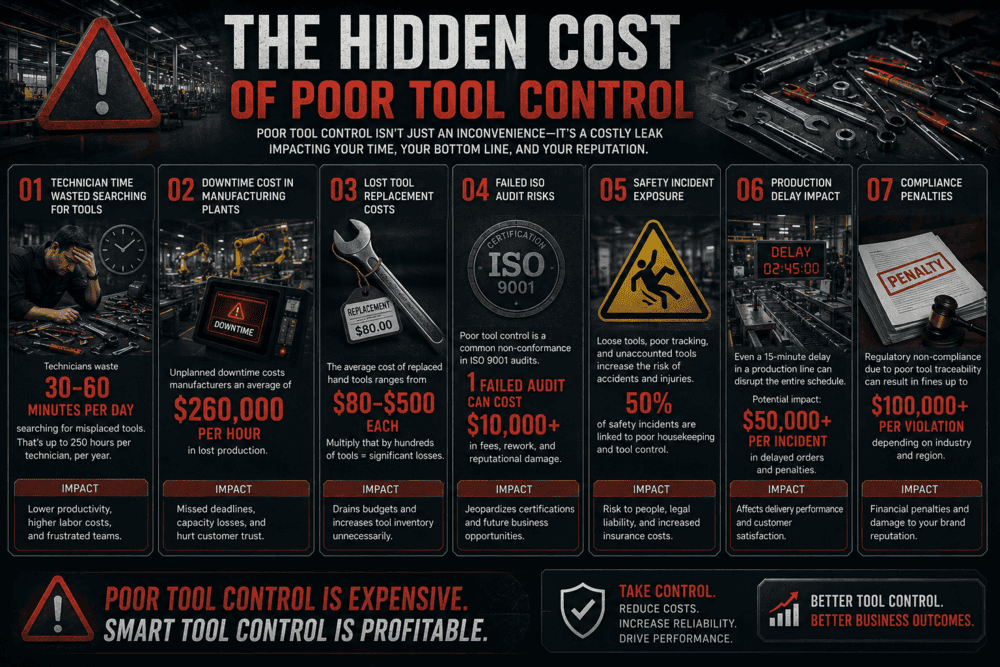
Direct replacement costs:
Direct replacement costs are the most visible: tools that are lost, damaged through improper handling, or simply “consumed” by a system with no accountability mechanism. In large facilities, this can represent hundreds of thousands of dollars annually in tools that were never properly tracked and therefore never recovered.
Productivity losses:
Productivity losses are larger but harder to attribute. Studies in lean manufacturing consistently show that technicians in poorly organized tool environments spend between 10 and 20 percent of their working time searching for tools, waiting for tools, or improvising because the right tool isn’t accessible. In a 50-person maintenance team, that’s the equivalent of five to ten people contributing nothing productive every day.
Compliance and audit exposure:
It is increasingly consequential. A missing tool log or an uncalibrated instrument found during an ISO audit creates corrective action requirements, potential certification risks, and in regulated industries, the possibility of production shutdowns. The cost of a failed audit — in remediation time, operational disruption, and reputational damage — routinely exceeds years of investment in a proper tool control system.
Safety incidents:
It represent the most severe category. In aviation, a tool left in an aircraft structure or engine compartment is a potential catastrophe. In oil and gas, a spark-generating tool used in an explosive atmosphere because the correct non-sparking alternative couldn’t be located is a life-safety event. These incidents are rare precisely because experienced industries have implemented tool control — but the absence of control is what makes them possible.
How Tool Control Systems Actually Work
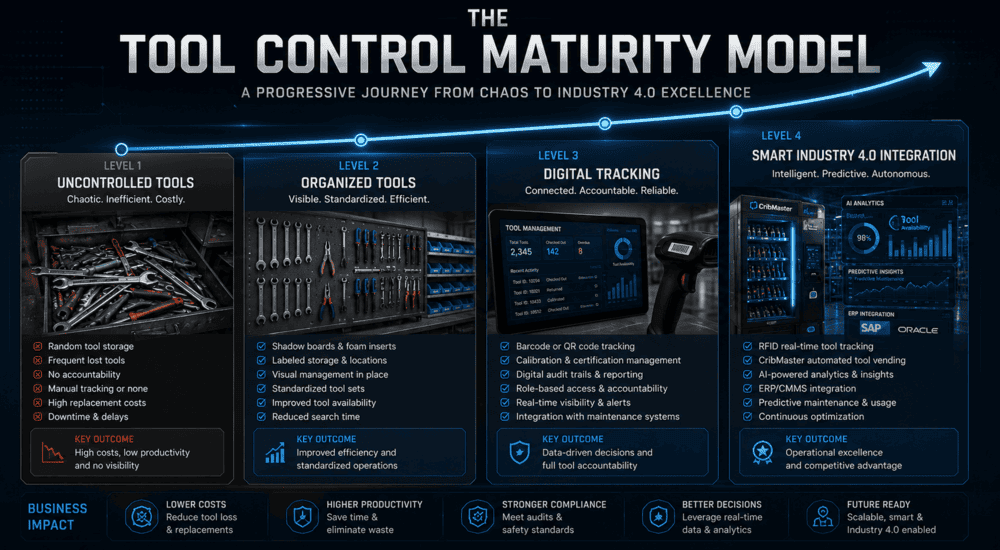
A well-implemented tool control system operates as a closed loop. Every tool has a defined home location, a unique identifier, and a record. Every departure from that home location is tracked to a specific person, job, or task. Every return is verified against the original issue. Any discrepancy triggers an alert and a search procedure before the job or shift is closed out.
In practice, this loop can be implemented at varying levels of technological sophistication, from entirely manual systems to fully automated digital platforms.
Manual or semi-manual systems
Typically use physical layouts — shadow boards, foam cut-out tool trays, tool kits with labeled insert positions — that make the presence or absence of each tool visually obvious. A shadow board in an aviation hangar, for example, shows the silhouette of every tool in a kit. If a tool is missing at shift end, it is immediately visible without counting or searching. A sign-out register or tag-out system creates a paper trail for tool movement. These systems are effective, low-cost, and require minimal technology. They remain the right choice for smaller operations or as the physical foundation of a more sophisticated digital system.
Barcode-based systems
Add a digital tracking layer. Each tool is tagged with a unique barcode, and check-out/check-in terminals at the tool crib or storage location record every transaction against a user account. The system generates timestamped usage records, alerts when tools are overdue for return or calibration, and produces audit-ready reports automatically. Barcode systems are the most widely deployed tool tracking technology in industrial environments today due to their balance of cost-effectiveness and capability.
RFID-based systems
Take this a step further by enabling automated, hands-free tracking. RFID tags embedded in tool handles or attached to tool cases can be read by scanners at doorways, benches, or storage locations without requiring individual scanning. This allows bulk tool audits to be completed in seconds, passive tracking of tool locations within a facility, and real-time inventory visibility. RFID is the preferred technology for high-value tool environments, large-scale operations, and facilities with strict compliance requirements.
Industrial vending and dispensing systems —
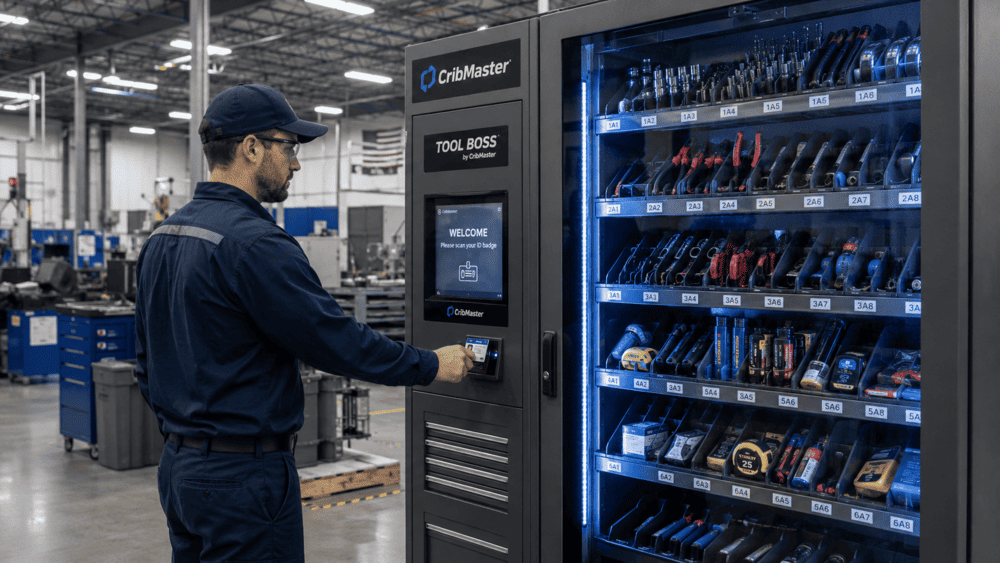
Industrial vending and dispensing systems like those available through CribMaster, which Brook Industrial Tools distributes in the UAE — bring vending machine-style dispensing and automated inventory management to tool cribs and point-of-use locations. Tools and consumables are dispensed only to authorized users, every transaction is recorded, and the system automatically reorders items when stock reaches defined thresholds. Since 1992, CribMaster has grown to offer over 25 hardware solutions that manage storerooms, tool cribs, and point-of-use dispensing through technologies including scales and RFID — making it one of the most mature and comprehensive platforms in industrial tool control. Explore CribMaster tool control and inventory management solutions at Brook Industrial Tools.
Shadow Boards: The Simplest Visual Control Method
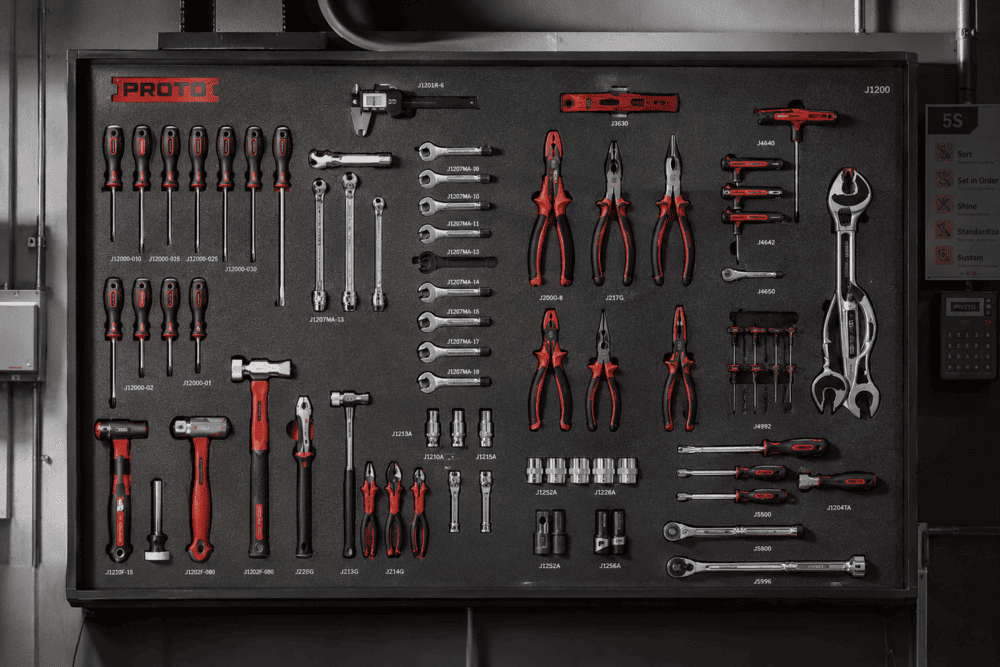
Before discussing sophisticated digital systems, it’s worth giving proper attention to shadow boards — one of the most elegantly simple and operationally effective tool control methods available.
A shadow board is a mounting board, typically wall-fixed in a workshop, tool crib, or maintenance bay, on which tools are stored in designated positions. Each position shows the silhouette or outline of the tool it holds. When a tool is in place, the shadow disappears behind it. When the tool is removed, the shadow is visible and immediately communicates that something is missing.
This visual management approach — borrowed from the 5S methodology in lean manufacturing — requires no technology, no software, and no training beyond brief familiarization. Its power lies in the speed and certainty of its communication. Any person entering the tool area, regardless of role or seniority, can instantly determine whether the tool set is complete. No counting, no checklist, no interrogating a database.
Shadow boards are particularly valuable in aviation maintenance, where FOD prevention procedures require verified tool counts before and after every maintenance task. They are also widely used in automotive manufacturing, heavy engineering workshops, and industrial maintenance departments as the visual accountability backbone of a broader tool control program.
Brook Industrial Tools offers shadow board solutions tailored to the specific tool sets used in aerospace, automotive, oil and gas, and general industrial maintenance environments, including custom-profiled foam inserts that accommodate specialist tools alongside standard hand tools. View foam cut-out and shadow board solutions from Brook Industrial Tools.
RFID and Barcode Tool Tracking: The Digital Revolution
The shift from paper-based tool management to digital tool tracking has been one of the most significant operational improvements available to industrial facilities over the past decade — and in 2026, it is no longer optional for any organization that takes compliance and efficiency seriously.
RFID (Radio Frequency Identification) technology works by embedding a microchip and antenna — the RFID tag — into or onto a tool. When the tag passes through the field generated by an RFID reader, it transmits its unique identifier automatically, without requiring line-of-sight or manual scanning. This seemingly simple capability has transformative implications for tool management.
In a typical RFID tool tracking implementation, tools are tagged at acquisition. When a technician signs out a tool, the reader at the dispensing station logs the transaction against the technician’s access credential. When the tool is returned, the reader logs its return. If the tool passes through any other reader — at a workshop exit, a maintenance bay entrance, or a fixed scanning station — its location is updated in the system. The result is a continuous, real-time record of where every tool is, where it has been, and who has had it.
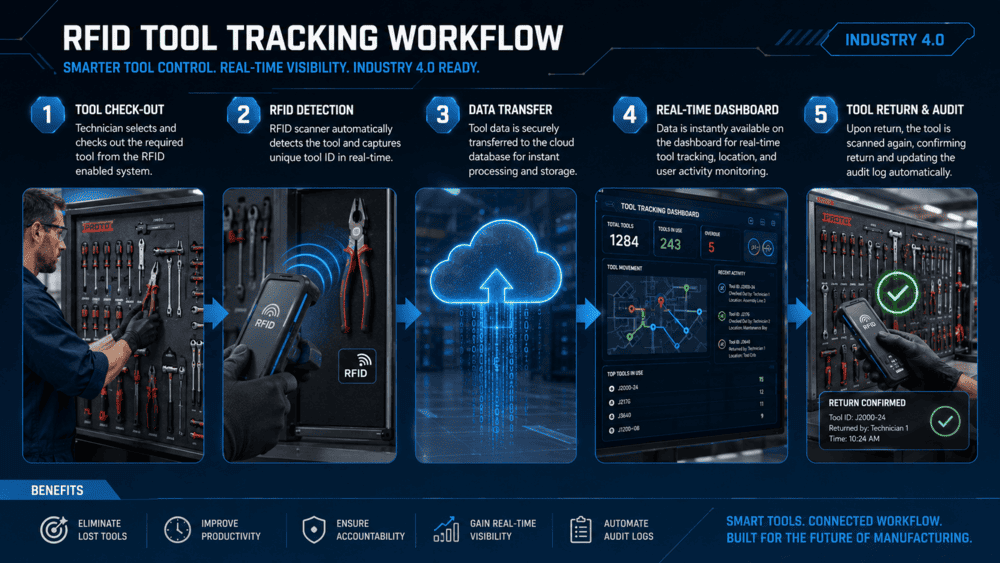
For calibration management, RFID systems can store calibration due dates in the tag or associate them with the tool’s digital record. A tool that is overdue for calibration can be automatically flagged, locked out of dispensing, or trigger an alert to the tool manager — preventing a calibrated instrument from being used outside its valid certification window.
Barcode-based systems deliver similar traceability with a simpler, lower-cost technology. While barcodes require manual scanning rather than passive automatic reading, modern handheld scanners and fixed scanning stations make the transaction fast enough for practical use in most operational environments. For organizations implementing tool tracking for the first time, barcode systems often represent the most cost-effective starting point.
Proto hand tools, which Brook Industrial Tools supplies across the Middle East and beyond, are designed with tool traceability in mind — available in comprehensive kits and tray configurations that lend themselves naturally to shadow board and barcode-tagged tracking systems. Their customized tool kits make it straightforward to implement a controlled tool set that is organized, inventoried, and ready for integration into a digital tracking platform.
Which Industries Need Tool Control the Most
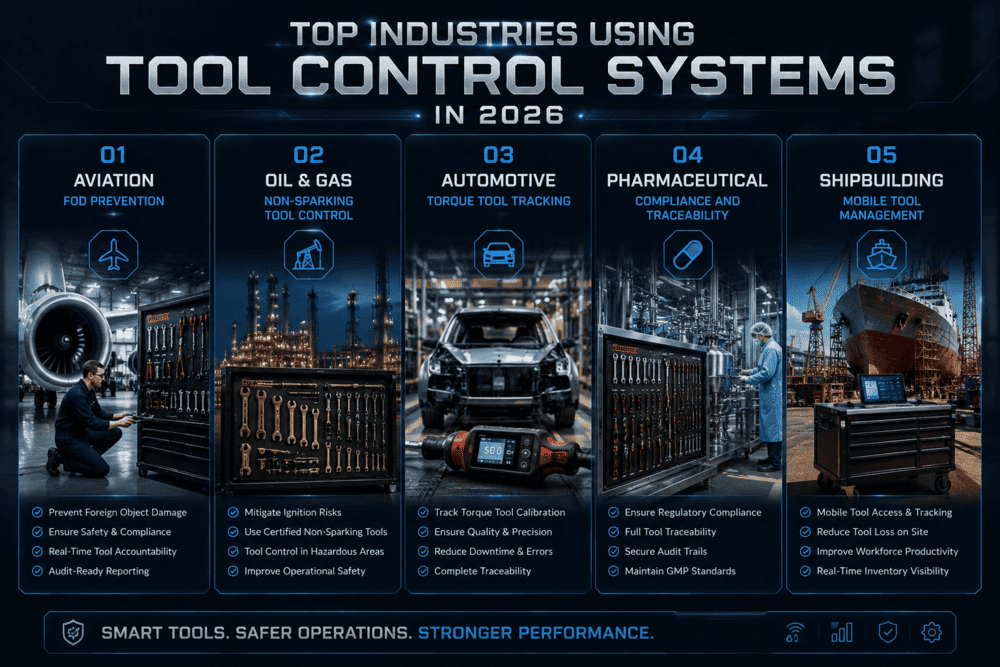
Tool control delivers value wherever tools are used professionally, but the urgency and the specific requirements vary significantly by sector.
Aviation and Aerospace
No industry has done more to develop tool control practice than aviation. The consequence of a tool being inadvertently left inside an aircraft structure during maintenance — contributing to what is called Foreign Object Debris (FOD) — ranges from equipment damage to catastrophic airframe failure. Aviation maintenance organizations worldwide operate under tool control regulations that require every tool to be accounted for at the start and end of every maintenance task, with documented verification. For aerospace manufacturers and MRO facilities, tool control is not a best practice — it is an airworthiness requirement. Learn more about aviation tool requirements at Brook Industrial Tools.
Oil and Gas
In upstream and downstream oil and gas environments, tool control addresses two distinct risk categories: safety-critical FOD in mechanical systems, and explosion risk from improper tool use in hazardous atmospheres. Non-sparking tools — manufactured from beryllium copper or aluminum bronze alloys — are mandatory in areas where flammable gases or vapors may be present. Without a control system, there is no reliable way to verify that the correct tool type was used in a given task. Brook Industrial Tools supplies non-sparking tools specifically for hazardous area applications, making them a practical anchor for tool control programs in oil and gas facilities.
Automotive Manufacturing
Automotive assembly operations combine high-volume repetitive tasks with precision torque requirements. Missing or uncalibrated torque tools in an automotive assembly line can result in fastener joint failures that lead to costly recalls — or worse, field safety incidents. Tool control in automotive manufacturing typically centers on torque tool calibration management and ensuring the correct tool is used at each assembly station, with documented verification for quality audit purposes.
Pharmaceutical and Food Processing
These regulated industries require full traceability of tools used in production environments to prevent product contamination. A tool that contacts a product or a product-contact surface must be identifiable, and its usage must be documented. Lost tools in pharmaceutical production can trigger batch rejection and regulatory investigation.
Heavy Engineering and Shipbuilding
Large-scale construction and maintenance projects in shipbuilding, power generation, and infrastructure present a different challenge: tools spread across large, complex environments where accountability is difficult to maintain without a structured system. Mobile tool storage systems, which Brook Industrial Tools offers, allow tool control to travel with the work rather than requiring technicians to return to a central crib location.
Tool Control and Aerospace: Why FOD Prevention Is Critical

Foreign Object Debris prevention deserves deeper treatment because it represents one of the most well-developed and consequential applications of tool control methodology anywhere in industry.
FOD in an aviation context refers to any object that is not supposed to be present in an aircraft, engine, or airside environment. Even a small hand tool, a fastener, or a piece of wire introduced into an aircraft structure during maintenance can cause catastrophic damage during flight. Historical incident investigations have repeatedly identified missing tools as a direct cause of aircraft damage, engine failure, and in the most serious cases, accidents with fatalities.
Aviation maintenance organizations — whether airline MRO departments, military aviation units, or airframe manufacturers — operate formal tool control programs that typically include: complete tool inventorying at the start of every job, shadow boards or foam-insert tool kits that make every tool’s presence or absence visually obvious, mandatory tool count verification before an aircraft is returned to service, and documented records of every tool used on every task.
The aviation tool control framework has become a model for other high-consequence industries. Oil and gas organizations have adopted similar FOD prevention concepts to address the risk of tools or hardware left in equipment during overhaul. Power generation facilities apply the same discipline to turbine maintenance. The principle transfers cleanly: in any environment where a missing tool inside a machine can cause injury, equipment damage, or operational failure, the aviation model of total tool accountability is the appropriate standard.
Insulated tool kits — another product category that Brook Industrial Tools carries — are the aerospace standard for electrical work, providing both tool organization and safety protection for work on energized equipment. View insulated tool kit solutions.
Tool Control and Industry 4.0 Integration
We are now deep enough into the Industry 4.0 era that the question is no longer whether tool management should be digitized, but how deeply it should be integrated with the broader digital manufacturing ecosystem.
In the most advanced implementations, tool control systems have become a component of the wider Industrial Internet of Things (IIoT) architecture. Tool usage data feeds into maintenance management systems (CMMS), informing predictive maintenance schedules by correlating tool usage patterns with equipment service histories. Calibration data integrates with quality management systems, creating automatic documentation for ISO audit trails. Inventory levels feed into procurement systems, enabling automated reordering that eliminates both stockouts and overbuying.
Artificial intelligence is beginning to add another layer of intelligence. Machine learning models trained on historical tool usage data can identify patterns that predict tool failure before it occurs — flagging a torque wrench that is beginning to show calibration drift before it goes out of tolerance, or identifying a drill that is being used more frequently than its maintenance cycle accounts for. This predictive capability moves tool management from a reactive, loss-reduction function to a proactive, reliability-enhancement function.
For organizations implementing or upgrading tool control in 2026, the key integration question is not just “how do we track our tools?” but “how does our tool data connect to the rest of our operational intelligence?” The organizations that answer this question thoughtfully will be positioned to extract value from their tool control investment that extends well beyond the tool room.
CribMaster’s platform, available through Brook Industrial Tools in the UAE, is designed with exactly this integration capability in mind — offering web-based, mobile, and desktop application versions of its core platform, built to connect with enterprise systems rather than operate as an isolated island.
What to Look for in a Tool Control Solution
For decision-makers evaluating tool control investments, the market presents a wide range of options at vastly different price points and capability levels. The right choice depends on operational scale, industry-specific compliance requirements, existing digital infrastructure, and the specific pain points being addressed.
Physical organization and visual management:
It is the non-negotiable foundation. Shadow boards, foam cut-out inserts, and properly organized mobile storage systems create the physical discipline without which no digital tracking system will be effective. A database that says a tool is present does not help if no one can find it in a cluttered cabinet. Brook Industrial Tools’ range of mobile storage systems
and workshop furniture provides this physical foundation.
Tracking technology:
It should match operational requirements. Barcode systems suit most mid-sized operations. RFID is appropriate for high-value tool environments, strict compliance requirements, or facilities where passive tracking provides significant operational advantage. Industrial vending — CribMaster’s domain — is ideal for high-frequency dispensing of consumables alongside controlled tools, with full user-level accountability.
Software capabilities:
It should include, at minimum: real-time inventory visibility, check-out and check-in transaction records, calibration due date tracking, and standard reporting for audits. Integration APIs that allow connection with existing CMMS, ERP, or quality management systems are increasingly important for organizations that take Industry 4.0 seriously.
Compliance readiness:
It should be explicitly verified. An ISO 9001 or ISO 45001 auditor will ask specific questions about tool traceability and calibration management. A solution that cannot produce a complete usage history for a specific tool over a specified period is not adequate for compliance purposes.
Scalability and support:
It matter for long-term value. A system that cannot grow with the operation, or that lacks responsive technical support, will create problems as the facility evolves.
How Brook Industrial Tools Supports Your Tool Control Strategy
Brook Industrial Tools, operating from Dubai since 2010, has built its reputation as one of the Middle East’s most trusted industrial tools suppliers by doing something that is rarer than it should be: understanding the operational context in which tools are actually used, not just selling products.
The company’s tool control portfolio spans the full spectrum of what a serious implementation requires. As the UAE’s authorized distributor for CribMaster — the industry benchmark in tool crib and inventory vending management since 1992 — Brook Industrial Tools brings a platform with 25+ hardware solutions, proven ROI documentation across aerospace, automotive, and government contractor applications, and a support infrastructure that includes RFID installation expertise and dedicated implementation services. Explore CribMaster Tool Control and Inventory Management.
For physical tool organization, Brook Industrial Tools supplies Proto hand tools — the American-made professional standard for over a century, manufactured under strict quality protocols and available in comprehensive customized tool kits and foam cut-out configurations that are the practical building blocks of any shadow board or aviation-standard tool kit system. Proto’s breadth of line — wrenches, sockets, torque tools, pliers, screwdrivers, and specialty instruments — means an entire facility’s controlled tool set can be sourced through a single trusted channel.
USAG premium hand tools complement this offering with a European precision engineering pedigree, including insulated tool kits rated for electrical safety and non-sparking tools for hazardous environments — both critical components of specialized tool control programs in oil and gas, utilities, and aerospace electrical maintenance. USAG’s vehicle storage systems and workshop furniture provide the mobile and fixed organization infrastructure that physical tool control depends on.
For pneumatic tool management — a frequently overlooked category in tool control programs — Brook Industrial Tools carries Chicago Pneumatic and Ingersoll Rand pneumatic tools, both brands with deep industrial pedigrees and maintenance documentation that supports calibration tracking and lifecycle management. Explore pneumatic tool solutions.
The company is ISO 9001 certified, serves clients across the UAE, Oman, Nigeria, and other markets, and offers design consultancy alongside product supply — meaning they can help an organization design a complete tool control system from shadow board layout through to CribMaster vending machine integration, rather than simply delivering a catalogue of products.
Implementation Roadmap: From Audit to Accountability
Implementing tool control is not a purchase decision — it is a process change. Organizations that buy shadow boards or vending machines and expect them to solve the problem without process discipline will be disappointed. The following roadmap reflects how successful implementations actually proceed.
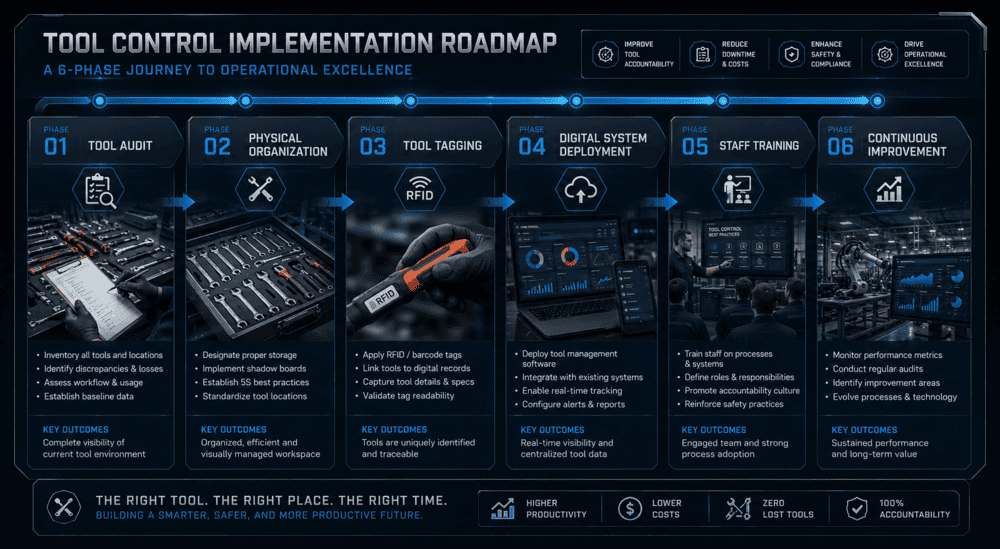
Phase 1: Tool Audit and Inventory Baseline
You cannot control what you haven’t counted. The first step is a complete physical inventory of all tools in use: catalogued by type, location, condition, calibration status, and assigned custodian or department. This audit is typically revealing — most organizations discover tools that were assumed lost, tools that are damaged and should have been replaced, and calibrated instruments that are significantly overdue. The audit output becomes the master inventory that the control system manages.
Phase 2: Organization and Physical Control
Tools are reorganized into the physical control structure: shadow boards, foam-insert tool trays, labeled cabinets, or standardized kit boxes. The principle is that every tool has a home, and the absence of a tool from its home is immediately visible without counting. Proto tool kits and USAG storage solutions from Brook Industrial Tools are well-suited to this phase.
Phase 3: Identification and Tagging
Every tool receives a unique identifier — a barcode label, RFID tag, or engraved serial number. This is the bridge between the physical organization system and any digital tracking platform. Tools that are already part of a serial-numbered inventory (many Proto and USAG products come with manufacturer identification) have a head start.
Phase 4: Digital System Deployment
The tracking platform — whether a barcode-based check-out system, CribMaster vending terminals, or an RFID system — is installed, configured with the master inventory, and tested. User access credentials are established. Calibration due dates are entered. Alert thresholds are configured.
Phase 5: Training and Procedure
The system is only as good as the discipline around it. Technicians, supervisors, and tool custodians need clear procedural training: how to check out and return tools, what to do when a tool is damaged, how to handle end-of-shift counts, and what escalation path to follow when a tool cannot be accounted for.
Phase 6: Measurement and Continuous Improvement
Tool control systems generate data. Reviewing that data regularly — which tools are most frequently missing, which calibration cycles are being missed, which users are the most frequent non-compliers — enables ongoing refinement that steadily improves the program’s effectiveness.
FAQ: Common Questions About Tool Control
What is tool control in manufacturing?
Tool control in manufacturing is a systematic approach to managing, tracking, and accounting for all tools used in production and maintenance operations. It ensures that tools are in the right place, in the right condition, and used by authorized personnel — reducing downtime, improving safety, and supporting quality and compliance requirements.
Why is tool control important in 2026?
In 2026, tool control is essential because of increasing regulatory compliance requirements (ISO 9001, ISO 45001, sector-specific standards), the operational cost of tool-related downtime, the availability of affordable digital tracking technology, and the integration of tool management into broader Industry 4.0 and IIoT frameworks. Industries that lack formal tool control face audit exposure, safety risk, and measurable productivity losses.
What is a shadow board and how does it work?
A shadow board is a wall-mounted display that holds tools in designated positions, with the outline or silhouette of each tool marked on the board. When a tool is present, it covers its outline. When a tool is removed, the empty silhouette remains visible — instantly communicating that a tool is missing without any counting or checking. Shadow boards are a core method in lean manufacturing’s 5S methodology and are widely used in aviation maintenance for FOD prevention.
What is RFID tool tracking?
RFID tool tracking uses radio frequency identification tags embedded in or attached to tools. RFID readers — placed at storage locations, doorways, or scanning stations — automatically detect and record tagged tools as they pass through, creating a continuous, timestamped record of tool location and usage without requiring manual scanning. RFID enables real-time inventory visibility and bulk audits in seconds.
What is CribMaster and how does it support tool control?
CribMaster is an industrial inventory management platform that combines vending machine-style dispensing hardware with sophisticated software for tracking tools, PPE, consumables, and other indirect materials. It restricts tool access to authorized users, records every transaction, manages calibration schedules, and generates audit-ready reports. Brook Industrial Tools is an authorized CribMaster distributor in the UAE.
What is FOD prevention in aerospace tool control?
FOD (Foreign Object Debris) prevention refers to the systematic procedures used to ensure that no tools, hardware, or materials are inadvertently left inside an aircraft structure, engine, or airside environment during maintenance. Tool control is the primary mechanism for FOD prevention — ensuring every tool issued for a maintenance task is verified to have been returned before the task is closed out.
Do I need tool control for ISO certification?
ISO 9001 and ISO 45001 both require organizations to control, calibrate, and maintain traceability of monitoring and measuring equipment, and to manage tools and equipment that affect product or workplace safety quality. While the standards don’t mandate a specific tool control system, auditors routinely assess whether organizations can demonstrate that their tool management practices meet these requirements. A formal tool control system with documented records is the most reliable way to satisfy these requirements.
How much does a tool control system cost?
The cost varies enormously depending on scale and technology. A shadow board system for a small workshop can be implemented for a few hundred dollars. A full CribMaster vending solution for a large manufacturing facility represents a significantly larger investment, but typically delivers measurable ROI through reduced tool replacement costs, productivity improvements, and compliance assurance. Brook Industrial Tools can provide detailed solution design and cost consultation for any scale of requirement.
What is a non-sparking tool and why is it part of tool control?
Non-sparking tools are manufactured from alloys — typically beryllium copper or aluminum bronze — that do not produce sparks when struck against metal surfaces. They are mandatory in explosive atmosphere environments: oil and gas facilities, chemical plants, grain handling, and other locations where flammable gases, vapors, or dusts may be present. Tool control in these environments must verify that only non-sparking tools are used in designated hazardous areas, and that standard steel tools cannot be inadvertently substituted.
How do I get started with tool control for my facility?
The most practical starting point is a complete tool audit to understand your current inventory. From there, a phased implementation — physical organization first, digital tracking second — delivers early operational wins while building toward a comprehensive system. Brook Industrial Tools can provide expert consultation to design a tool control program suited to your industry, facility size, and compliance requirements.
Partner with Brook Industrial Tools for Your Tool Control Program

If you’re managing a manufacturing facility, maintenance department, aviation operation, oil and gas plant, or any industrial environment where tools are critical to safe and efficient operations, the question is no longer whether to implement tool control — it is how to implement it well.
Brook Industrial Tools brings over a decade of industrial supply expertise, ISO 9001 certification, and a product portfolio specifically assembled for serious tool control programs: CribMaster vending and inventory management systems, Proto customized tool kits and foam cut-out solutions, USAG insulated and non-sparking tools, mobile storage systems, and shadow board solutions — all supported by a team that understands the operational contexts in which these systems are deployed.
Whether you’re starting from a full audit and building a program from scratch, upgrading an existing manual system to digital tracking, or sourcing specific components for a compliance-driven implementation, Brook Industrial Tools is equipped to be a genuine industrial partner — not just a catalogue.
Contact Brook Industrial Tools:
- Phone: +971 4 8866104
- Email: info@brookindustrialtools.com
- Request a Quote: brookindustrialtools.com/request-a-quote
- Location: 215, Umm Ramoul, Shed 2, Dubai, UAE