![Industrial foam cut out tool kit with precision-cut black and orange foam insert for organised tool storage.]](https://www.brookindustrialtools.com/wp-content/uploads/2026/11/112764-1568x626.jpg)
The Industrial Buyer’s Guide to Foam Cut-Out Solutions: Pre-Cut, Custom, and Everything Between
![Industrial foam cut out tool kit with precision-cut black and orange foam insert for organised tool storage.]](https://www.brookindustrialtools.com/wp-content/uploads/2026/11/112764.jpg "112764")
Why Most Foam Cut-Out Purchases Get It Wrong Before the Order Is Even Placed
The conversation about foam cut-outs in industrial tool management usually begins and ends in the wrong place. It starts with “which material should we use?” — a legitimate question, but the second question in the sequence, not the first. Or it starts with a quick catalogue search, a price comparison, and a purchase order for whatever looks closest to what the facility already uses.
Neither approach serves the buyer well. The maintenance manager who orders the wrong system type — not the wrong material, but the wrong type of system entirely — ends up with an organized tool kit that doesn’t actually solve the operational problem they were trying to address. And the procurement officer who buys on unit cost without thinking through total cost of ownership will be repeating the same purchase within 18 months.
This guide exists to fill that gap. If you want a technical comparison of EVA versus XLPE foam properties, Brook Industrial Tools has already written that — it’s in the Foam Cut Out Materials Guide. If you want to understand what foam cut-outs are and why UAE industries use them, the Foam Cut Out UAE overview page covers that ground. What neither of those articles covers — and what this one does — is the procurement decision framework: how to choose the right system type, how to build the ROI case, how to spec an order that a supplier can actually execute correctly, and how to implement it without the mistakes that make most first deployments costlier than they needed to be.
The Three System Types — and Why Choosing the Wrong One Is the Most Expensive Mistake
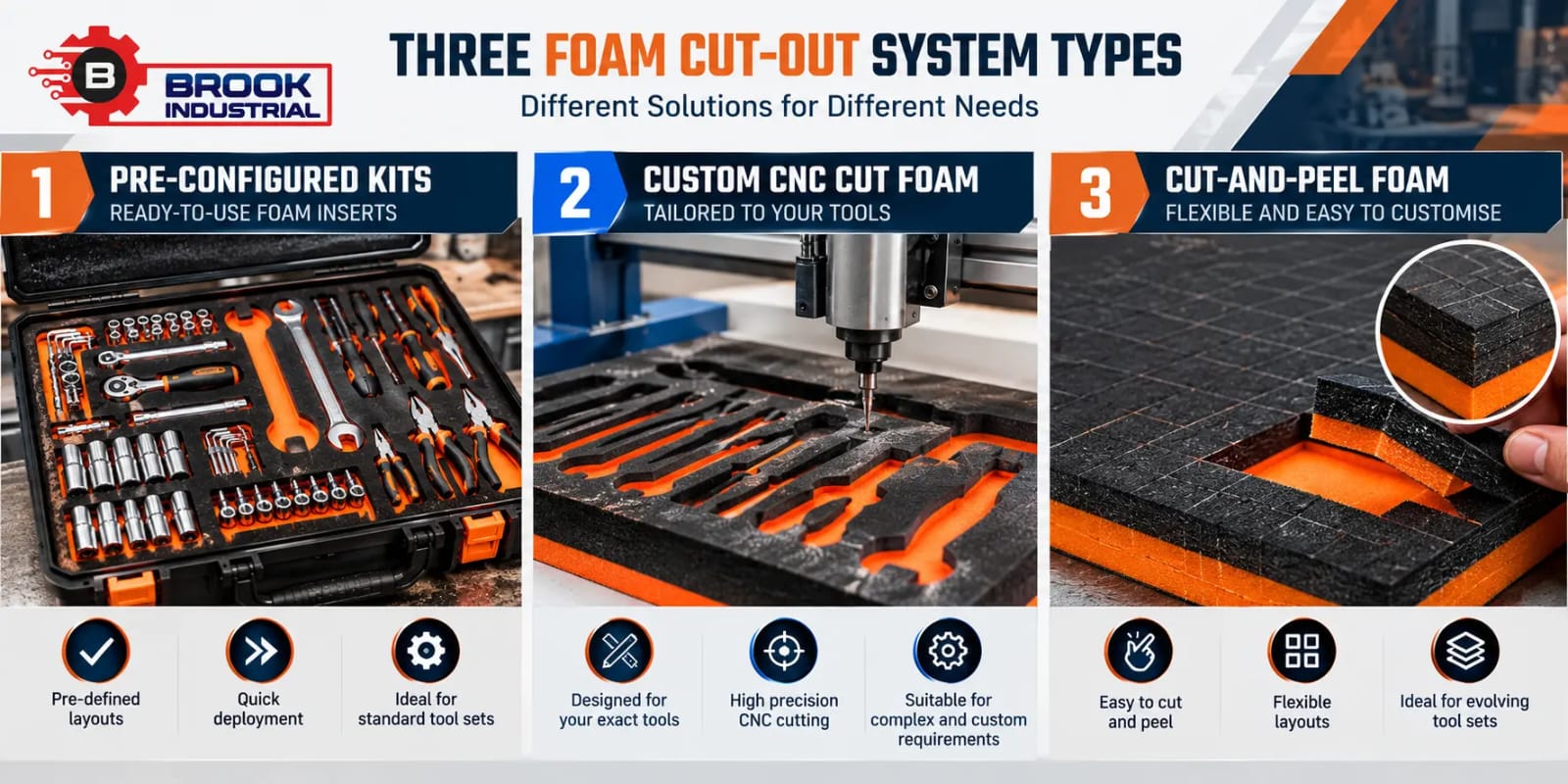
The foam cut-out market offers three fundamentally different approaches to industrial tool organization. They are not interchangeable, they serve different operational requirements, and they have different total cost profiles over the life of the system. The decision between them should come before material selection, before supplier selection, and before price comparison.
The three types are:
Pre-configured foam tool kits —
A defined tool set paired with foam inserts already cut to match those exact tools. The kit arrives ready to use.
Custom CNC-cut inserts —
Foam inserts cut to any tool profile specified by the buyer, using computer-controlled routing. Suitable for non-standard, specialist, or mixed-brand tool inventories.
Cut-and-peel DIY systems —
Pre-scored foam sheets that facility staff cut and peel to create tool pockets themselves. Maximum flexibility; variable precision and durability.
Each is the correct answer to a different operational question. The failure mode is buying a cut-and-peel system for a compliance-critical aviation environment because it was cheaper, or ordering expensive custom CNC inserts for a standard hand tool set that a pre-configured Proto kit would have covered identically at lower cost and with shorter lead time.
The sections that follow break each type down in the detail a procurement decision requires.
Pre-Configured Foam Tool Kits: When They Work and When They Don’t
Pre-configured kits are the fastest path to foam cut-out tool accountability. The tool set is defined by the manufacturer, the foam profiles match those tools exactly, and the system is ready to deploy from the moment it arrives on site.
The commercial logic is strong when the operational conditions are right: standardized tool sets, consistent requirements across multiple locations or shifts, and procurement in volume. A large automotive service network outfitting fifty technician bays with identical tool sets will almost always find pre-configured kits more cost-effective than custom cutting — the development cost for a custom insert is amortized across a large quantity, but the per-unit cost still exceeds a well-designed pre-configured product from an established manufacturer.
Proto hand tool kits — one of Brook Industrial Tools’ core product lines — represent exactly this value proposition. Proto’s foam-lined kits are designed around the specific tool geometries in each kit, providing the close-tolerance profile fit that visual accountability requires. The foam configuration reflects decades of professional tool design — each tool seated at an ergonomic angle, the layout organized for logical workflow rather than arbitrary space-filling. For organizations standardizing maintenance kits across multiple bays, shifts, or facilities, the consistency this delivers is operationally significant: every technician works from an identically organized kit, which matters for compliance verification and cross-shift accountability. View Proto customized tool kits.
![Pre-configured industrial foam cut out insert with neatly organised hand tools in a ready-to-use tool kit.]](https://www.brookindustrialtools.com/wp-content/uploads/2026/11/112765.jpg "112765")
Where pre-configured kits are the right choice:
- Standard professional tool sets (hand tools, socket sets, torque tools) in common configurations
- Multi-location standardization programs
- Aviation and aerospace facilities using CTK (Consolidated Tool Kit) structures based on standard tool sets
- High-volume procurement where per-unit cost matters at scale
Where they are not the right choice:
- Non-standard or specialist tool inventories that do not match available pre-configured options
- Mixed-brand tool sets accumulated over time
- Facilities with unique specialist instruments — calibration equipment, gauges, avionics tools, industry-specific measurement instruments
- Environments where the tool set is subject to regular change (the foam insert becomes obsolete every time the tool set changes)
Custom CNC-Cut Inserts: What the Procurement Process Actually Looks Like
For organizations whose tool sets do not match available pre-configured options, custom CNC-cut foam inserts are the professional solution. CNC routing cuts foam to any profile provided in a digital design file — tolerances are measured in fractions of a millimetre, and the resulting pockets are engineered fits rather than approximate shapes.
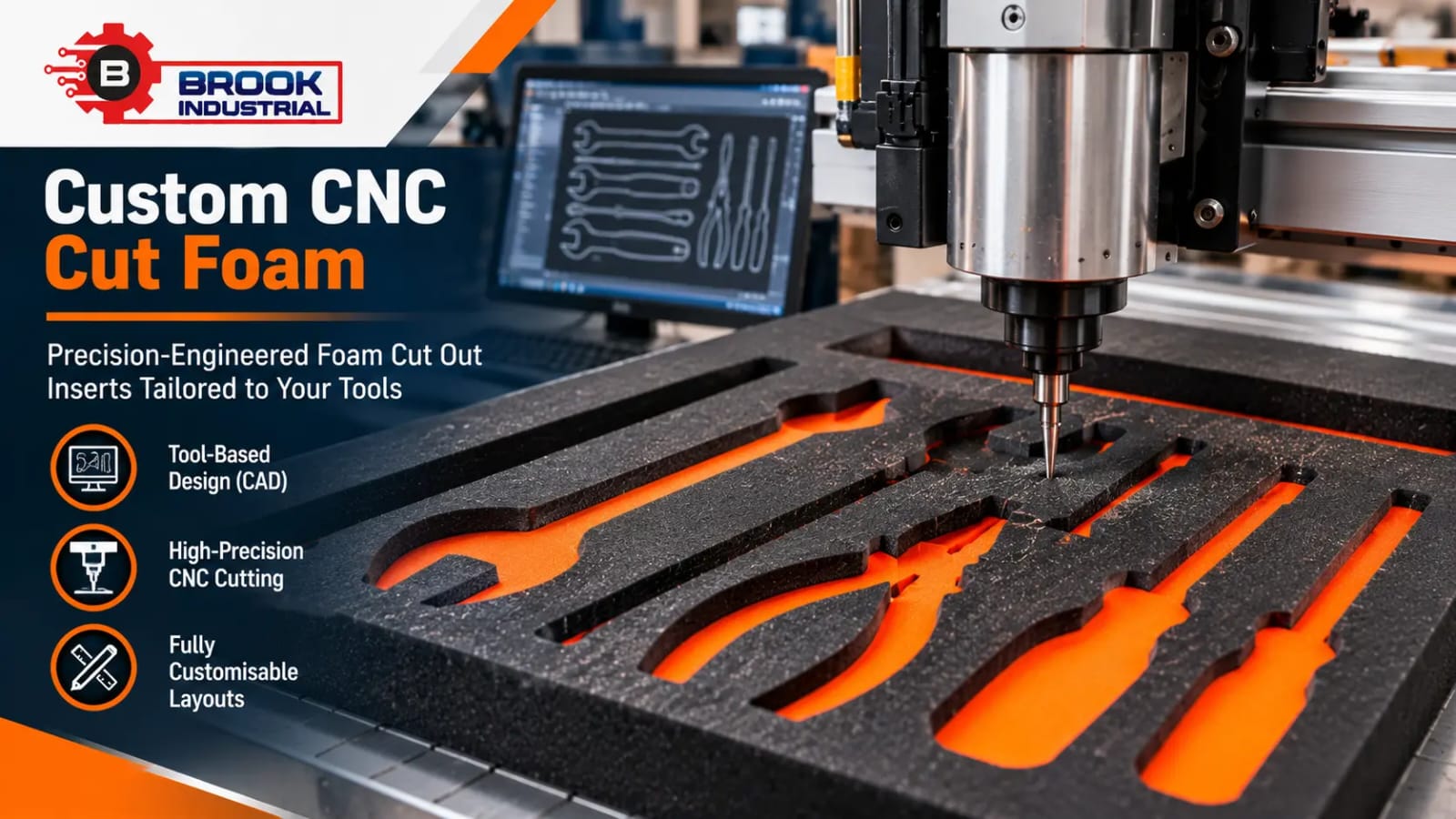
The procurement process for custom inserts has several steps that buyers frequently misunderstand or skip, which is where most custom foam projects go wrong.
Step 1: Tool profiling. CNC cutting requires a profile specification for every tool. This can come from several sources: a digital design file (DXF or DWG format) the buyer provides, a template tracing the supplier provides as a service, or in some cases a 3D scan of the tool for complex geometries. Buyers who hand a supplier a list of tool model numbers and expect profiles to appear are often surprised to discover the supplier needs more. Clarify at the outset what profile sourcing method the supplier uses and who is responsible for profile accuracy.
Step 2: Layout design. Individual tool profiles need to be arranged in a logical layout within the foam insert’s overall dimensions. This is design work, not just cutting work. A well-designed layout puts frequently used tools in accessible positions, groups related tools logically, and leaves enough foam material between pockets to maintain structural integrity. Ask whether the supplier provides a layout review before cutting — some do, many do not.
Step 3: Sample verification. Before ordering a full quantity, request a physical sample insert with representative profiles cut and verify tool fit against actual tools. This step is routinely skipped to save time and routinely regretted. A profile that is one millimetre too tight requires force to remove the tool, damaging both the foam and the tool surface over time. A profile that is two millimetres too large defeats the visual accountability purpose — the tool moves freely in its pocket and does not register as unmistakably present. Confirming fit at the sample stage costs a small fraction of what a full-run error costs.
Step 4: Material specification. This is where the Foam Cut Out Materials Guide becomes directly relevant — read it before specifying material for a custom order. The supplier needs a material specification (not just “foam”), including the foam family, grade, density range, colour scheme for the dual-layer configuration, and any special requirements (anti-static, chemical resistance, fire rating). A supplier who accepts a custom order without asking for a material spec is not running a professional operation.
Step 5: Documentation for compliance. For ISO-audited environments, the custom foam order should generate documentation: a kit drawing or layout record showing which profiles are in the insert, the material specification, and the kit identifier that connects the physical insert to the tool inventory record it supports. Ask for this explicitly — it will not be offered automatically by most suppliers.
Brook Industrial Tools’ foam cut-out service for UAE clients includes design consultancy capability — meaning they can support the profiling, layout, and material specification process rather than simply executing a file the buyer hands them. For organizations without in-house CAD capability, this matters. Contact Brook Industrial Tools for a custom foam cut-out consultation.
Cut-and-Peel DIY Systems: The Right Tool for the Right Job, Not a Universal Solution
Cut-and-peel foam systems — pre-scored foam sheets that staff cut and configure in-house — have a legitimate place in an industrial foam cut-out program. They are also the most frequently misapplied option, because their low unit cost makes them attractive in contexts where they will underperform.
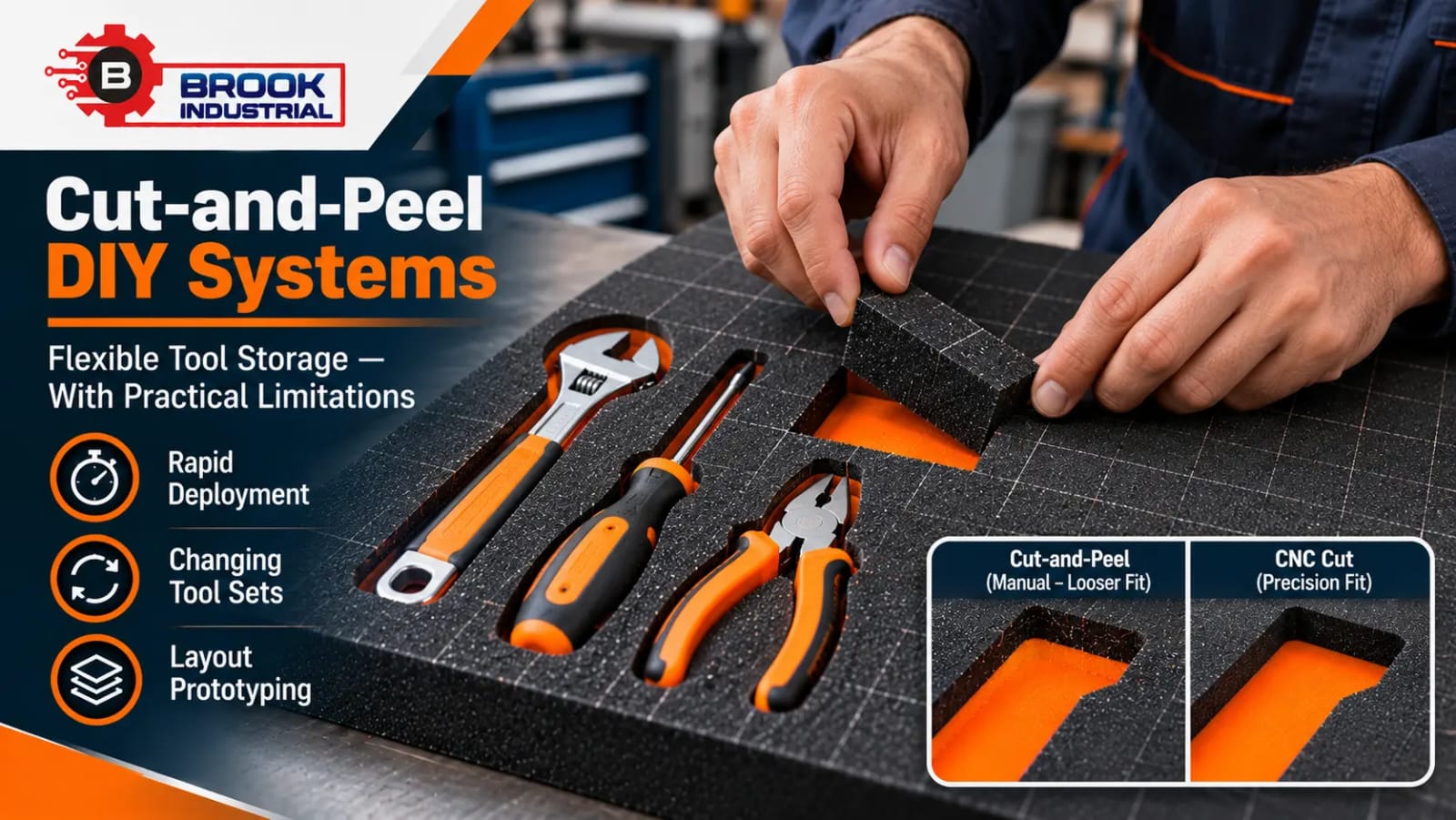
Cut-and-peel is appropriate for:
- Rapid deployment before a permanent custom system arrives — the kit is organized and visually accountable from day one, even if the profiles are not as precise as CNC-cut versions
- Frequently changing tool sets where a permanent custom insert would need to be recut every time the tools change
- Prototyping layouts before commissioning a CNC order — staff can experiment with arrangement using cut-and-peel before locking in a layout for precision cutting
- Low-frequency use storage in non-compliance-critical environments where professional precision is not operationally required
Cut-and-peel is not appropriate for:
- Aviation and FOD-critical environments. Layered cut-and-peel PE foam can shed small particles as the layers separate with use — a foreign object debris risk that has no place in an aircraft maintenance environment. For FOD-sensitive zones, CNC-cut foam in a solid (non-layered) grade is the correct specification.
- High-frequency heavy-tool use. Manual cutting does not achieve the profile tolerance that CNC cutting does. Pockets in cut-and-peel inserts are typically looser, which means the tool can move slightly in its pocket — acceptable for light use, not acceptable in a professional tool accountability system where the visual indicator needs to be unambiguous.
- Any environment where the system will be shown to an auditor. A professionally cut CNC insert communicates systematic tool management. A hand-cut foam sheet communicates improvisation. The physical evidence is part of the audit signal.
The Total Cost of Ownership Calculation Most Buyers Skip
Unit cost is the number that appears on the purchase order. Total cost of ownership is the number that should drive the procurement decision, and in foam cut-out procurement specifically, the gap between them is substantial.
The full TCO calculation for a foam cut-out system includes:
Acquisition cost — unit price × quantity, plus any design/tooling fees for custom work.
Installation and setup — the time cost of transitioning from existing storage to the new system. Pre-configured kits have near-zero installation time. Custom inserts require a structured changeover. Cut-and-peel requires significant staff time for cutting and configuration.
Operational productivity gain — the time saved by technicians who no longer search for tools. Independent efficiency data from foam-organized tool kit studies consistently places retrieval-and-return time improvement at 15–20% compared to unorganized storage. In a team of 20 maintenance technicians, this is a meaningful recurrent saving that compounds monthly.
Reduced tool replacement cost — tools in foam inserts are protected from impact, vibration damage, and loss. The reduction in annual tool replacement spend varies by facility but is routinely cited by operations managers as the most visible cost improvement after implementing foam accountability systems.
Compliance and audit cost avoidance — the cost of a failed ISO audit includes the auditor’s time, the corrective action program, and in some sectors the risk of operational suspension. The cost is difficult to predict but the probability of a tool-accountability-related finding drops significantly with a documented foam cut-out system in place.
Replacement and maintenance cost — foam inserts are consumable items. High-quality EVA or XLPE in a well-managed environment has a service life of 4–6 years. Low-quality PE in a heavy-use environment may need replacement within 18 months. The cost difference in the initial purchase is smaller than the difference in replacement frequency over the system’s life.
The procurement question that reframes the decision: Don’t ask “what does this foam insert cost?” Ask “what does it cost us per tool kit per year, including replacement cycle, labor productivity improvement, and compliance risk reduction?” That number almost always justifies a higher-quality system than the unit price comparison suggests.
Building the ROI Case for Finance Teams
For plant managers who need to make the case to a procurement committee or finance function, the ROI argument for foam cut-out systems has four components, each of which can be quantified with facility-specific data.
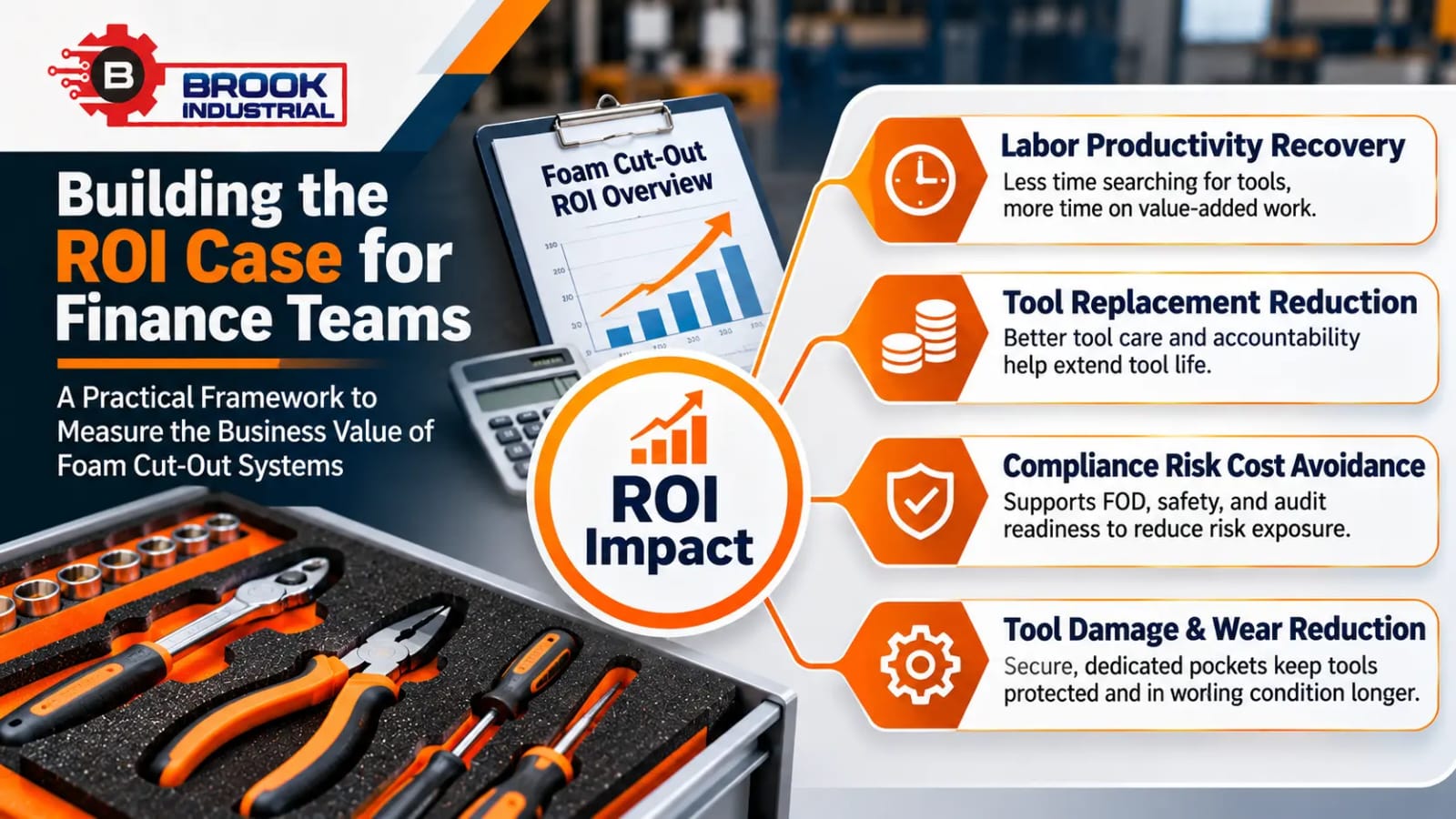
Component 1: Labor productivity recovery. Take the number of maintenance technicians in scope. Estimate their average current tool-search time per shift (honest facilities typically find this is 10–20 minutes). Multiply by the labor rate and the number of working days per year. This is the annual productivity cost of not having visual tool accountability. A foam cut-out system that recovers even half of this time is delivering measurable return.
Example: 30 technicians × 15 minutes/shift × AED 75/hour × 250 working days = AED 140,625 in recovered productivity annually.
Component 2: Tool replacement reduction. Pull the last 12–24 months of tool replacement purchase orders. Identify what proportion of replacements were for tools recorded as “lost” or “not found” rather than worn or damaged. In facilities without accountability systems, this proportion is typically 30–50% of total tool replacement spend. A foam cut-out system with proper check-out/check-in procedures eliminates most of this category.
Component 3: Compliance risk cost avoidance. Estimate the cost of a single ISO audit finding related to tool management — corrective action program, retesting, operational disruption. For most industrial facilities this is a five-figure cost minimum. Assign a probability to that event occurring in the next 12 months without a formal tool accountability system, and calculate the expected cost. Compare to the cost of the foam cut-out implementation.
Component 4: Tool damage and wear reduction. Estimate current annual spend on tool repair and replacement attributable to improper storage (tools banging loose in drawers, handling damage from being piled rather than stored). Industry data consistently places this reduction at 20–35% of storage-related tool maintenance costs after implementing organized foam storage.
Foam cut-out systems typically pay back their acquisition cost within 12–18 months in mid-to-large facilities. In high-turnover, high-compliance environments — aviation MRO, oil and gas, pharmaceutical manufacturing — the payback can be substantially faster.
The Compliance Angle: What Auditors Actually Look For
Compliance with ISO 9001, ISO 45001, and sector-specific standards like AS9100 is one of the most compelling drivers for foam cut-out adoption in UAE industries. But there is a specific misunderstanding in how many facilities approach this: they implement foam inserts and expect them to satisfy the audit requirement. They do not fully satisfy it alone — they satisfy the physical organization element of a broader tool control requirement.
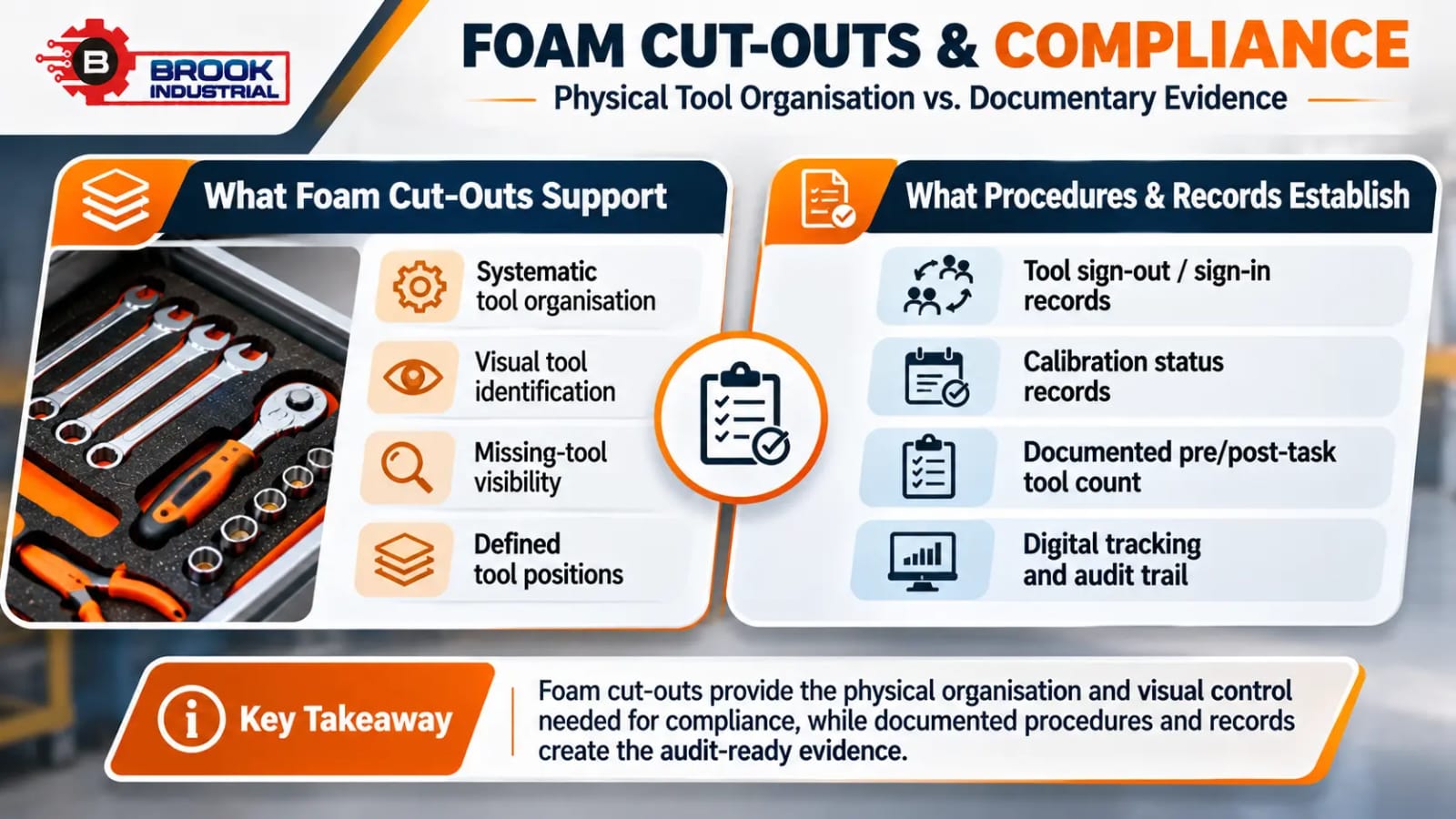
Here is what an ISO 9001 auditor is actually checking in a tool storage audit:
- Are tools organized systematically? Foam cut-outs directly satisfy this — every tool has a defined position, and the organization method is visually evident.
- Is the absence of a tool immediately detectable? A dual-layer high-contrast foam insert directly satisfies this — the empty pocket is the alert.
- Is there a record of tool usage and calibration status? This is where foam alone is insufficient. The auditor wants a record of when calibrated instruments were last verified, and a transaction log showing who used what tool on which job. This requires a sign-out system, a logbook, or a digital platform.
- Can the organization demonstrate that it would detect a missing tool before a safety-critical task is completed? The combination of foam visual accountability plus a documented pre/post task tool count procedure satisfies this directly.
The practical takeaway: foam cut-outs are a necessary component of a compliant tool management system, not a sufficient one on their own. For organizations that want to close the full compliance gap, foam cut-outs combined with a digital tracking layer — CribMaster’s vending and tracking platform, available through Brook Industrial Tools, provides the full documentation layer — covers every element an ISO or AS9100 auditor will examine. Explore CribMaster digital tool control.
The foam cut-out is the physical foundation. The digital record is the documentary evidence. Both are required for a complete compliance posture.
What to Ask a Foam Cut-Out Supplier Before You Sign Off
Most foam cut-out procurement conversations in UAE industrial markets are not sophisticated enough to protect the buyer. The following questions, asked before a purchase order is raised, will quickly distinguish a supplier who can actually deliver a professional industrial system from one who is selling a commodity product.
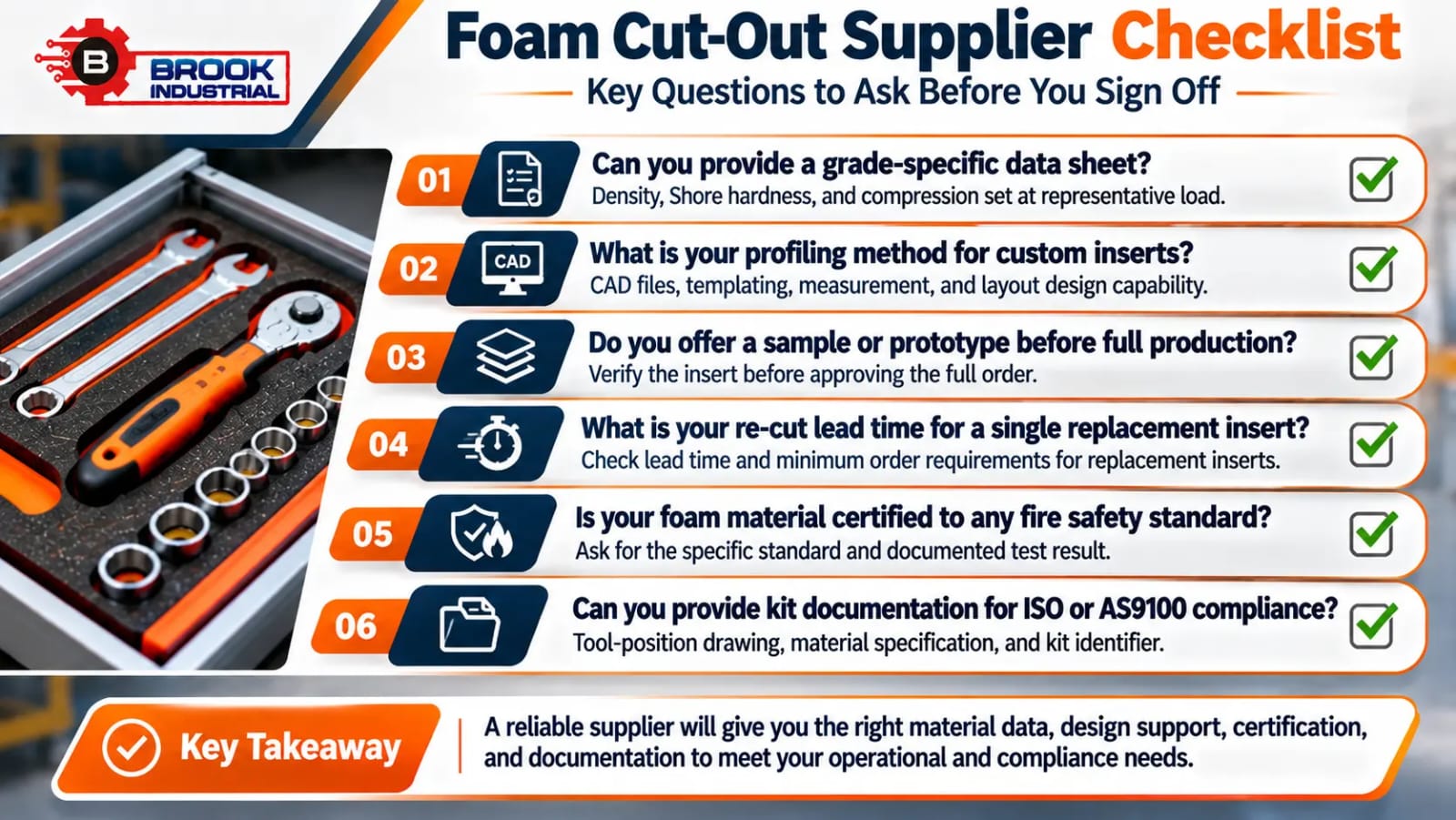
- Can you provide a grade-specific data sheet — not a family description? “EVA foam” is not a specification. The grade’s density (kg/m³), Shore hardness, and compression set at representative load are the numbers that predict real-world performance. A supplier who cannot provide these is not running a professional operation.
- What is your profiling method for custom inserts? Do they require you to supply a CAD file? Do they offer a templating or measurement service? Do they have the engineering capacity to design a layout, or are they simply cutting profiles you hand them?
- Do you offer a sample or prototype before full production? This is non-negotiable for any custom order above a certain quantity. A supplier who resists sample requests is not confident in their own output.
- What is your re-cut lead time for a single replacement insert? Tool inventories change. If a facility needs one replacement insert for a kit where a tool has been added or substituted, the lead time and minimum order requirement for that re-cut determines how practical the system is to maintain. A supplier requiring a minimum order of 50 units for a re-cut is not a practical long-term partner for an industrial facility.
- Is your foam material certified to any fire safety standard? In aviation hangars, oil and gas facilities, and other fire-safety audited environments, the foam material’s fire rating needs to be documented. Ask for the specific standard and test result, not a marketing claim.
6. Can you provide kit documentation for ISO or AS9100 compliance? A drawing or layout record showing tool positions, the material specification, and the kit identifier is the documentary evidence the compliance layer requires. Not all suppliers produce this as a standard deliverable — ask for it explicitly.
The Implementation Sequence That Avoids the Common Failures
Deploying foam cut-outs effectively is not complicated, but it has a sequence that matters. The facilities that report the most problems with their foam cut-out systems almost always skipped one of the first two steps.
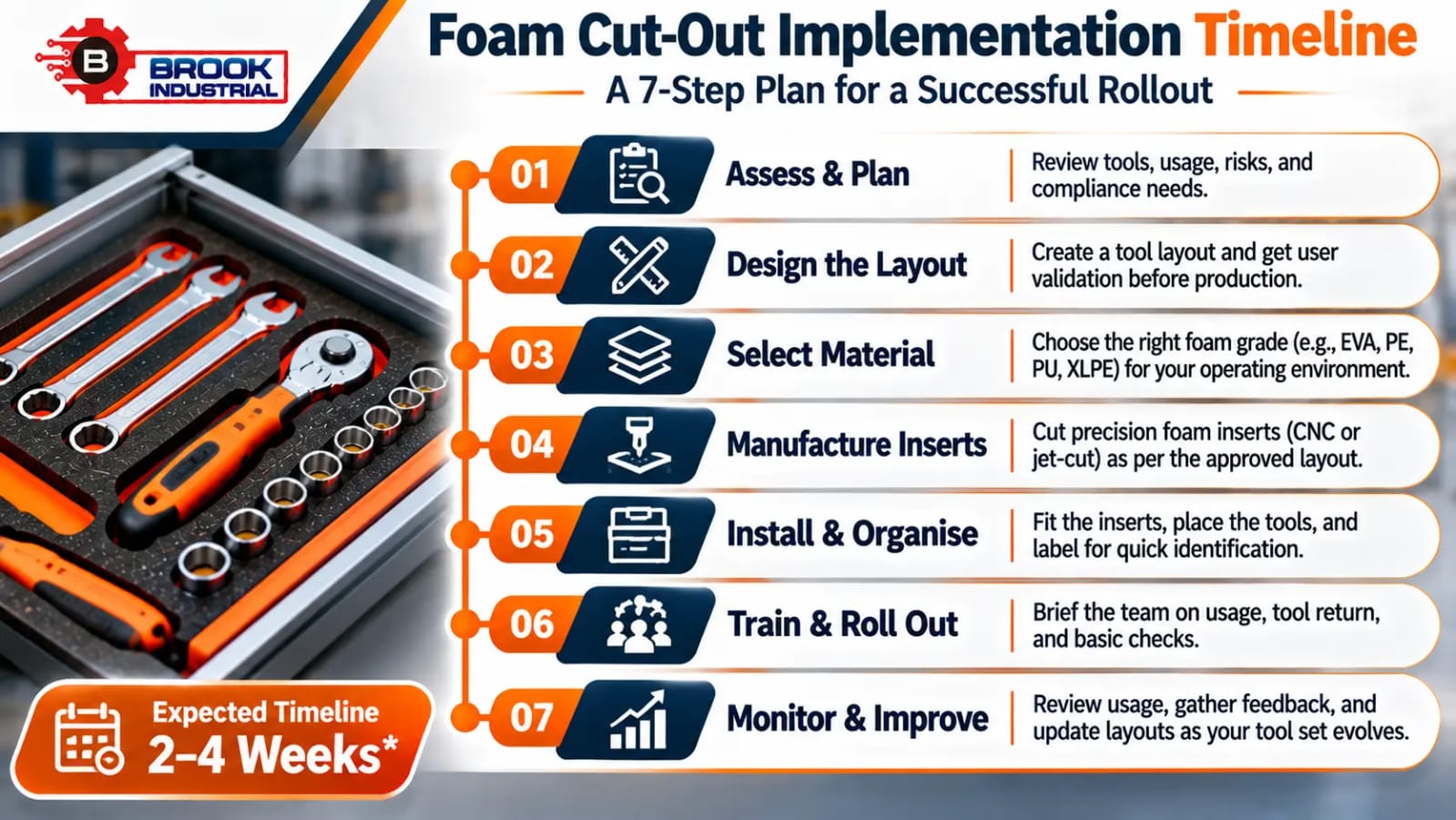
Step 1 — Complete tool audit first. Before any foam is ordered or cut, every tool in scope needs to be inventoried: model, size, condition, and calibration status. Damaged tools should be replaced before the foam system is designed around them. Calibration-due instruments should be serviced. A foam insert designed around a damaged or non-current tool inventory is already out of date on day one.
Step 2 — Standardize the kit definition. Decide exactly what belongs in each kit configuration. This step frequently surfaces duplication (two identical tools in a kit because the second was ordered when the first was assumed lost) and gaps (tools the team has been improvising around). Resolving this before designing the foam insert prevents the most common cause of “the foam doesn’t fit our actual workflow” complaints.
Step 3 — Choose system type against the criteria in this guide. Pre-configured, custom CNC, or cut-and-peel — decided on operational fit, not price alone.
Step 4 — Specify material correctly. Refer to the Foam Cut Out Materials Guide for the full material selection framework. In summary: closed-cell PE for most general industrial applications, XLPE for heavy-duty, aerospace, and chemical environments, EVA for high-precision high-frequency-use applications. Avoid open-cell PU for any oil or wet environment.
Step 5 — Verify fit before full deployment. For custom inserts: sample first. For pre-configured kits: physically check every profile against the actual tools in the specific configuration being deployed, not just the catalogue description.
Step 6 — Establish the procedure alongside the physical system. The foam insert provides the visual indicator. The procedure determines what happens when the indicator fires — who is responsible for a missing tool search, what escalation path exists, what documentation is required before a job is closed out with a tool unaccounted for. A foam insert without a procedure is a better-organized mess, not a tool control system.
Step 7 — Connect to your digital accountability layer if applicable. For ISO-audited environments, the foam system needs to be connected to a documentary record of tool usage. This can be as simple as a paper sign-out register or as sophisticated as a CribMaster integration. The choice depends on facility scale and compliance requirements.
Where Industrial Foam Cut-Out Technology Is Heading
The fundamentals of foam cut-out tool accountability are not going to change — a shaped pocket that makes a missing tool visually obvious is a simple, effective, and durable solution that no technology disruption can make obsolete. But the ecosystem around foam cut-outs is evolving in ways that are relevant for facilities planning long-term tool management strategies.
RFID-enabled foam systems are an emerging integration point. RFID tags embedded in tool handles or tool bodies, read by scanners at storage locations, complement foam visual accountability with digital transaction records. The foam shows that a tool is absent; the RFID record shows who took it and when. Several specialist manufacturers are beginning to offer foam insert designs that accommodate RFID readers at the insert level — the scanner is built into the drawer or case, and every tool removal and return is logged automatically. This integration is still early-stage in most industrial markets, but facilities planning 5–10 year tool control roadmaps should treat it as a near-term option rather than a distant possibility.
Modular and configurable foam systems are becoming more commercially accessible. Historically, custom foam inserts were a single-piece solution that required a full replacement when the tool set changed. Modular insert systems — where individual sections can be reconfigured or replaced independently — are increasingly available at reasonable cost, making foam cut-out systems more practical for facilities with evolving tool inventories.
Digital profile libraries are beginning to reduce the cost and lead time of custom foam ordering. As manufacturers build libraries of standard tool profiles in CAD format, the design step for a custom order becomes faster and the minimum viable order quantity decreases. Facilities that previously needed to order 20+ identical inserts to justify custom cutting are increasingly able to order smaller quantities as profile libraries mature.
UAE Vision 2031 and GCC industrial buildout will continue to drive demand for professional tool management systems across the region. As UAE manufacturing capacity expands and regulatory frameworks mature, the expectation that industrial facilities operate with documented tool accountability will increase. Organizations that establish professional foam cut-out systems as part of a broader tool control program now are building operational infrastructure that supports the compliance requirements of the next decade, not just the current year.
How Brook Industrial Tools Supports Your Foam Cut-Out Program
Brook Industrial Tools has been supplying industrial tool solutions from Dubai since 2010, serving aviation, oil and gas, manufacturing, marine, and heavy engineering clients across the UAE, Oman, Nigeria, and beyond. Their foam cut-out offering addresses all three system types from a single supplier.
Pre-configured Proto foam tool kits deliver standardized, professionally designed foam accountability for organizations standardizing tool sets across multiple positions or locations. Proto’s century-long heritage in professional hand tools means the kit design reflects genuine operational expertise, not catalogue assembly. Explore Proto tool kits.
Custom foam cut-out design and supply for specialist tool sets, non-standard inventories, and compliance-critical applications. Brook’s team can support the profiling, layout design, and material specification process — particularly valuable for organizations without in-house CAD capability. Request a custom foam cut-out consultation.
USAG workshop storage systems — including tool cabinets, vehicle storage, and mobile tool trolleys — integrate with foam inserts to provide the complete physical tool accountability infrastructure from storage unit through to individual tool pocket. Explore USAG storage solutions.
CribMaster digital tool tracking — for organizations ready to add the documentary accountability layer on top of their physical foam organization. Brook is the authorized UAE distributor for CribMaster, the industrial benchmark in tool crib management and vending since 1992. Explore CribMaster.
![Brook Industrial Tools support banner featuring USAG tool storage solutions, foam cut-out tool inserts, and CribMaster digital tool management systems for industrial tool control.]](https://www.brookindustrialtools.com/wp-content/uploads/2026/11/112766.jpg "112766")
Brook Industrial Tools is ISO 9001 certified — their own quality management system meets the standard they help clients achieve.
For the material specification decision, refer to Brook’s Foam Cut Out Materials Guide. For UAE-specific procurement and custom foam solutions, the Foam Cut Out UAE page covers local supply, custom design, and contact details.
FAQ
What is the difference between a pre-cut foam kit and a custom foam cut-out? A pre-cut foam kit is manufactured to match a specific standard tool set — it arrives ready to use. A custom foam cut-out is CNC-cut to match any tool profile you specify. Pre-cut kits suit standard tool inventories and are faster and more cost-effective for volume procurement. Custom inserts are necessary for non-standard, specialist, or mixed-brand tool sets.
What is a cut-and-peel foam system? Cut-and-peel foam is a pre-scored foam sheet that facility staff cut and peel to create tool pockets in-house. It offers maximum flexibility and low cost. It is appropriate for rapid deployment, prototyping, and frequently changing tool sets, but is not suitable for aviation FOD-critical environments or any application where auditor-quality precision is required.
Which foam system type is best for an ISO-audited facility? For ISO compliance, the system type matters less than the quality of implementation and the documentary record it supports. A pre-configured kit or custom CNC insert, combined with a documented sign-out procedure or digital tracking system, satisfies ISO 9001 and ISO 45001 tool management requirements. Cut-and-peel is generally not the appropriate choice for compliance-critical environments.
How do I calculate the ROI on a foam cut-out system? The four main ROI components are: labor productivity recovered from reduced tool-search time, tool replacement costs avoided, compliance risk cost avoidance, and tool damage and wear reduction. Most mid-to-large industrial facilities recover the investment within 12–18 months. The article above includes a worked example using UAE labor rate assumptions.
Do foam cut-outs on their own satisfy ISO tool control requirements? No — foam cut-outs satisfy the physical organization and visual accountability requirements. ISO 9001 and ISO 45001 also require documentary evidence of tool usage and calibration status. A foam system needs to be paired with a sign-out procedure or a digital tracking platform (such as CribMaster) to satisfy the full audit requirement.
What should I ask a foam cut-out supplier before ordering? Request a grade-specific data sheet (not just the material family name), confirm their profiling method for custom work, ask for a sample before full production, clarify re-cut lead time for individual replacement inserts, ask for fire-rating certification if your environment requires it, and request kit documentation for compliance records.
Where can I get custom foam cut-out solutions in the UAE? Brook Industrial Tools supplies custom and pre-configured foam cut-out solutions across Dubai, Abu Dhabi, Sharjah, and the wider UAE. Contact Brook Industrial Tools or request a quote for a consultation.
What is the typical service life of an industrial foam insert? High-quality closed-cell EVA or XLPE foam in a well-managed industrial environment typically lasts 4–6 years before requiring replacement. Low-quality PE in heavy-use, oil-exposed environments may need replacement in 12–18 months. Specifying the right material for the environment significantly extends service life — see the Foam Cut Out Materials Guide for material-by-environment guidance.
Choose the Right System Once. Implement It Right the First Time.
The difference between a foam cut-out system that delivers years of reliable tool accountability and one that is replaced within 18 months comes down to three decisions made before the purchase order is raised: choosing the right system type, specifying the right material, and asking the right questions of the supplier.
Brook Industrial Tools works with maintenance teams, quality managers, and procurement teams across UAE industries to make those three decisions correctly — from pre-configured Proto tool kits ready to deploy today, to fully custom CNC-cut inserts engineered to your exact tool inventory, to complete tool control programs combining foam organization with CribMaster digital tracking.
Contact Brook Industrial Tools:
- Phone: +971 4 8866104
- WhatsApp: +971 4 3244848
- Email: info@brookindustrialtools.com
- Request a Quote: brookindustrialtools.com/request-a-quote/
- Location: 215, Umm Ramoul, Shed 2, Dubai, UAE