Foam Cut Out Materials Compared: Which Foam Is Right for Your Tool Control System?
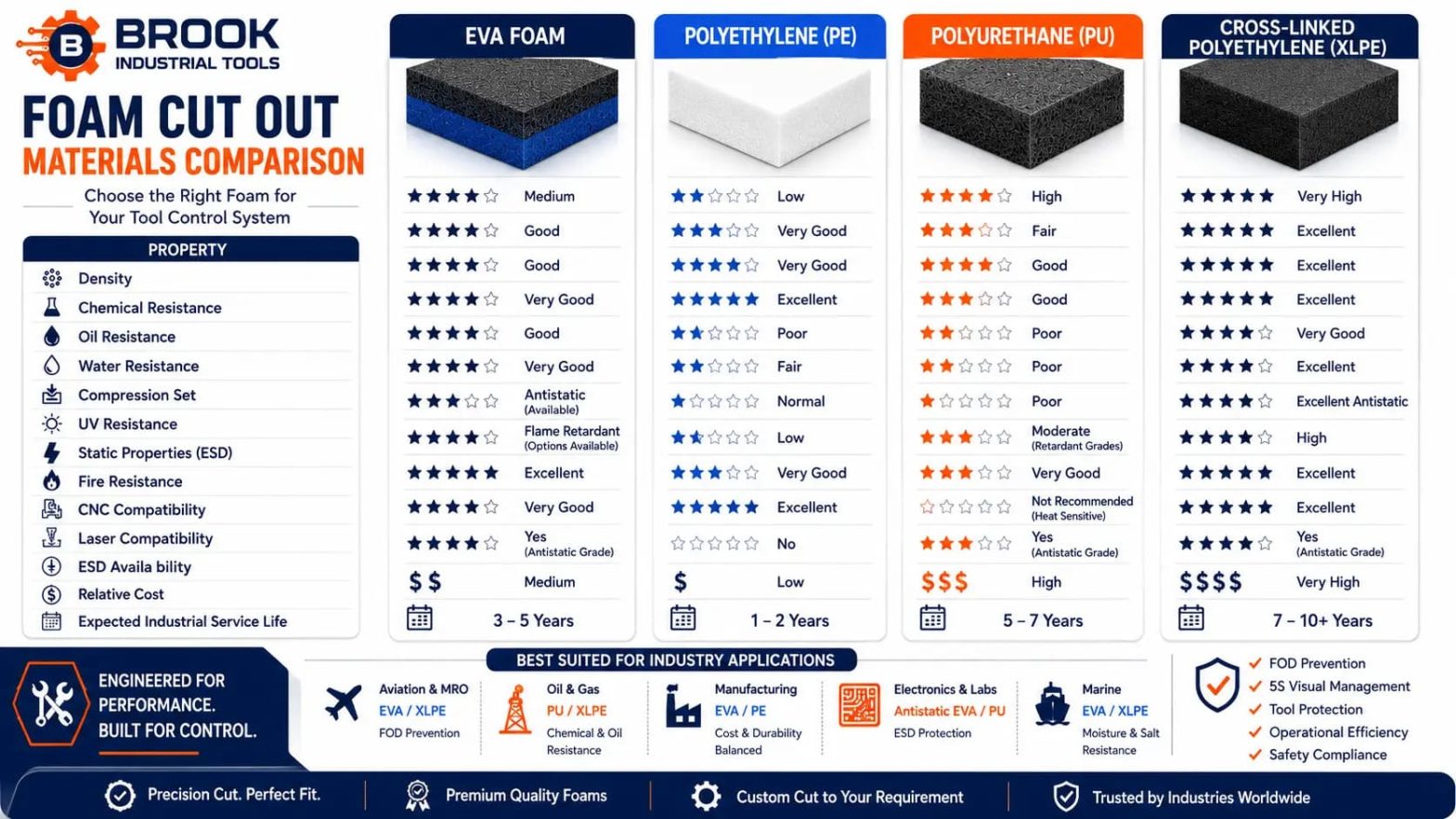
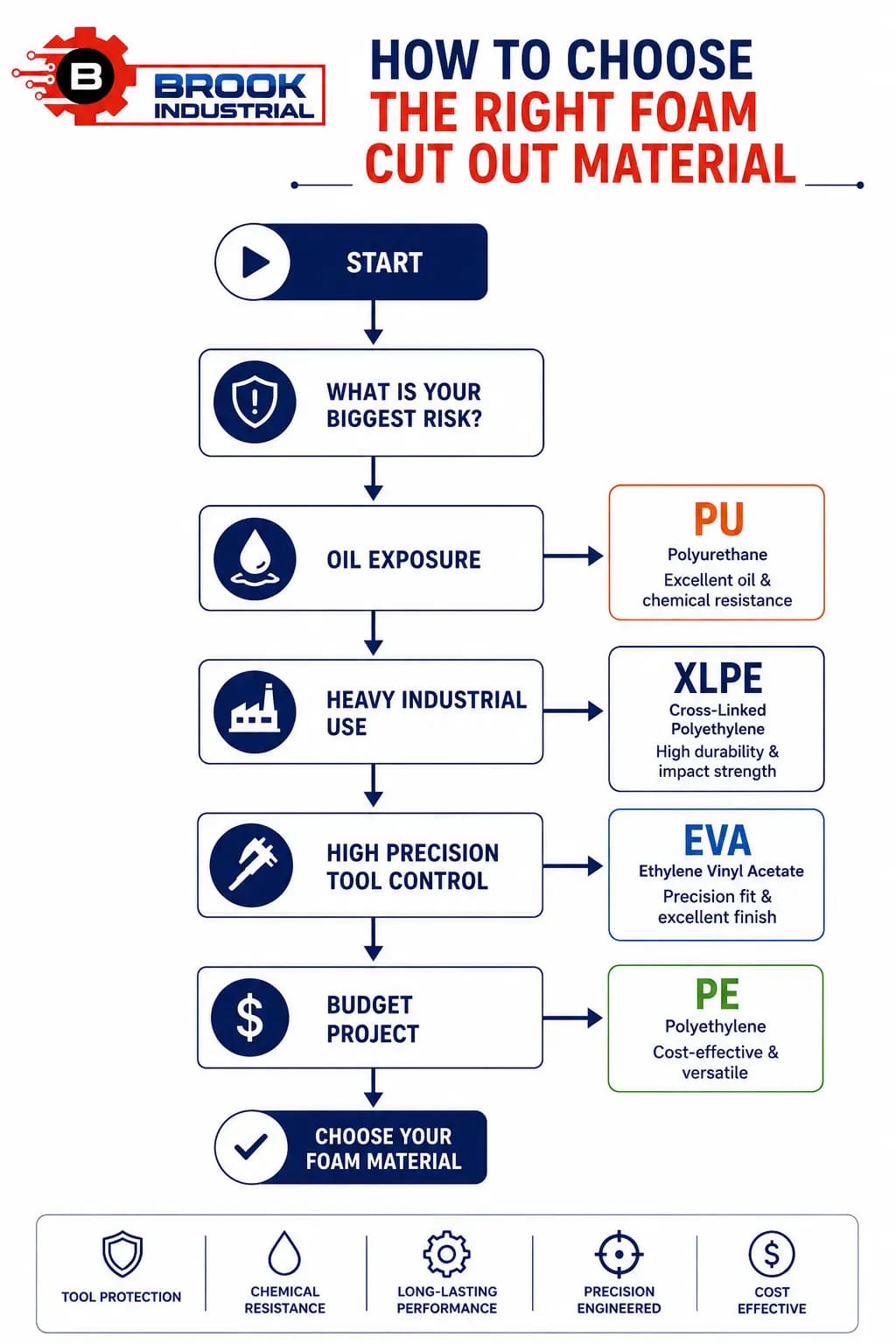
Choosing a foam cut-out system is only half the decision. The material the foam is made from determines whether that system holds up in an oil-soaked engine bay, survives a Dubai summer inside a metal container, or quietly becomes an FOD risk on an aircraft apron. This guide compares the four foam materials used in industrial foam cut outs — EVA, polyethylene, polyurethane, and cross-linked polyethylene (XLPE) — so you can specify the right one the first time.
If you’re still deciding whether foam cut-out systems are right for your facility at all, our complete Foam Cut Out guide for UAE industries covers the fundamentals, benefits, and compliance case. This article picks up from there and focuses specifically on material selection.
Why the Foam Material You Choose Matters More Than the Cut-Out Design
Two facilities can install what looks like the identical foam cut-out system — same layout, same two-tone shadow design, same tool set — and get very different results within a year. One holds up. The other delaminates, stains, hardens, or starts shedding particles into a clean environment.
The difference is almost always the base material, not the cutting technique. CNC and laser cutting can shape any of these foams with equal precision, so the process isn’t where the real decision happens. The decision happens in the material spec sheet: density, cell structure (open vs closed), chemical resistance, and static behavior. Get that wrong and you’ve bought a tool control system that fights your environment instead of supporting it.
The 4 Main Foam Cut Out Materials at a Glance
| Foam Type | Best For | Chemical/Oil Resistance | Static Properties | Relative Cost | Typical Lifespan |
| EVA (Ethylene-Vinyl Acetate) | High-precision, high-durability tool sets
——— |
Good | Available in anti-static grades | Medium-High | Long (5+ years, heavy use) |
| Polyethylene (PE) | General tool boxes, cost-sensitive projects
——— |
Moderate | Standard grades are static-neutral | Low-Medium | Medium |
| Polyurethane (PU) | Delicate instruments, chemically harsh environments
——— |
Excellent | Poor (can generate static — avoid in electronics areas) | Medium | Medium-Long |
| XLPE (Cross-Linked PE) | Heavy industrial, high-impact, outdoor storage | Very Good | Good | Medium | Long |
Engineering Specifications: Density, Hardness, Compression Set & Temperature Resistance
Comparison tables that only say “good” or “moderate” don’t help a procurement or QA team write a purchase spec. Here are the actual engineering ranges you should expect a supplier’s data sheet to cover. These are typical ranges across commercial industrial grades — always request the specific grade’s data sheet rather than assuming a family-wide average, since density and hardness are independently tunable within each foam family.
| Property | EVA | Polyethylene (PE) | Polyurethane (PU) | XLPE |
| Density | ~35–280 kg/m³ (higher-density grades used for industrial tool inserts) | ~30–480 kg/m³ depending on grade | ~160–480 kg/m³ (10–30 pcf for rigid/molded grades) | ~30–100+ kg/m³, engineered for a finer, more uniform cell structure than standard PE. |
| Hardness | Shore OO ~45–55 (ISO 868 / ASTM D2240) — tunable independently of density | Comparable Shore OO range to EVA in similar-density grades | Softer, more compressible feel in standard cushioning grades; rigid PU grades exist separately for structural use. | Shore hardness varies widely by grade; generally firmer feel than standard PE at equivalent density. |
| Compression Set | ~10–25% at 25% compression (22hr/23°C), rising at 50% compression — varies significantly by density | Broadly similar closed-cell behavior to EVA; specific values vary by grade | Higher compression set is common in softer open-cell PU grades — a key reason PU tool pockets can loosen faster under constant heavy-tool pressure. | Cross-linking generally improves compression set performance versus standard PE at comparable density. |
| Service Temperature | Roughly -70°C to 65–75°C intermittent, depending on grade | Moderate — commonly cited up to ~80°C (176°F) continuous for standard PE | Varies widely by formulation; flexible PU grades tolerate less heat than rigid/molded grades. | Best-in-class among the four — commonly cited up to ~90°C (194°F) continuous, briefly higher. |
| Fire Rating | Typically self-extinguishing/pass horizontal burn tests in standard grades; flame-retardant grades available | Flame-retardant grades available (e.g., FMVSS 302 pass); standard grades are not inherently fire-rated | Flame resistance varies enormously by formulation — flexible PU is rated B1/B2 or UL94 only when specifically flame-retarded; untreated PU is comparatively flammable. | Generally described as fire-retardant and self-extinguishing in cross-linked formulations, non-dripping. |
| Water Absorption | Low — closed-cell structure resists moisture well | Low — closed-cell PE resists hydrolysis and does not degrade with moisture exposure | Higher in open-cell grades, which absorb water readily; closed-cell/ester-based PU grades resist moisture far better than ether-based. | Very low — closed-cell, negligible water absorption reported in cross-linked grades. |
| UV Resistance | Moderate; UV-stabilized grades available for outdoor/semi-outdoor use | Moderate; degrades with prolonged unprotected UV exposure unless stabilized | Generally weaker UV resistance unless specifically stabilized. | Comparatively strong among the PE family when properly formulated. |
| Governing Test Standards | ASTM D3575, ISO 7214, ISO 868, ASTM D2240 | ASTM D3575, ASTM D1667 | ASTM D2240 (hardness), UL 94 / GB 8624 (fire), ASTM D2863 (oxygen index) | ASTM D3575 family, manufacturer-specific cross-link test protocols |
Technical Note: Material properties such as density, compression characteristics and hardness should always be verified using recognised industry testing standards before finalising procurement specifications.
Reading this table correctly matters as much as the numbers themselves. Two foams in the “EVA” family can differ by a factor of 5-8x in density depending on grade, and density and hardness are controlled independently — so “EVA foam” alone is not a complete purchase specification. Always request the specific grade’s density (kg/m³), Shore hardness, and compression set at the load your heaviest tool will apply, not just the material family name.
Manufacturing Methods: CNC Routing vs Laser Cutting by Material
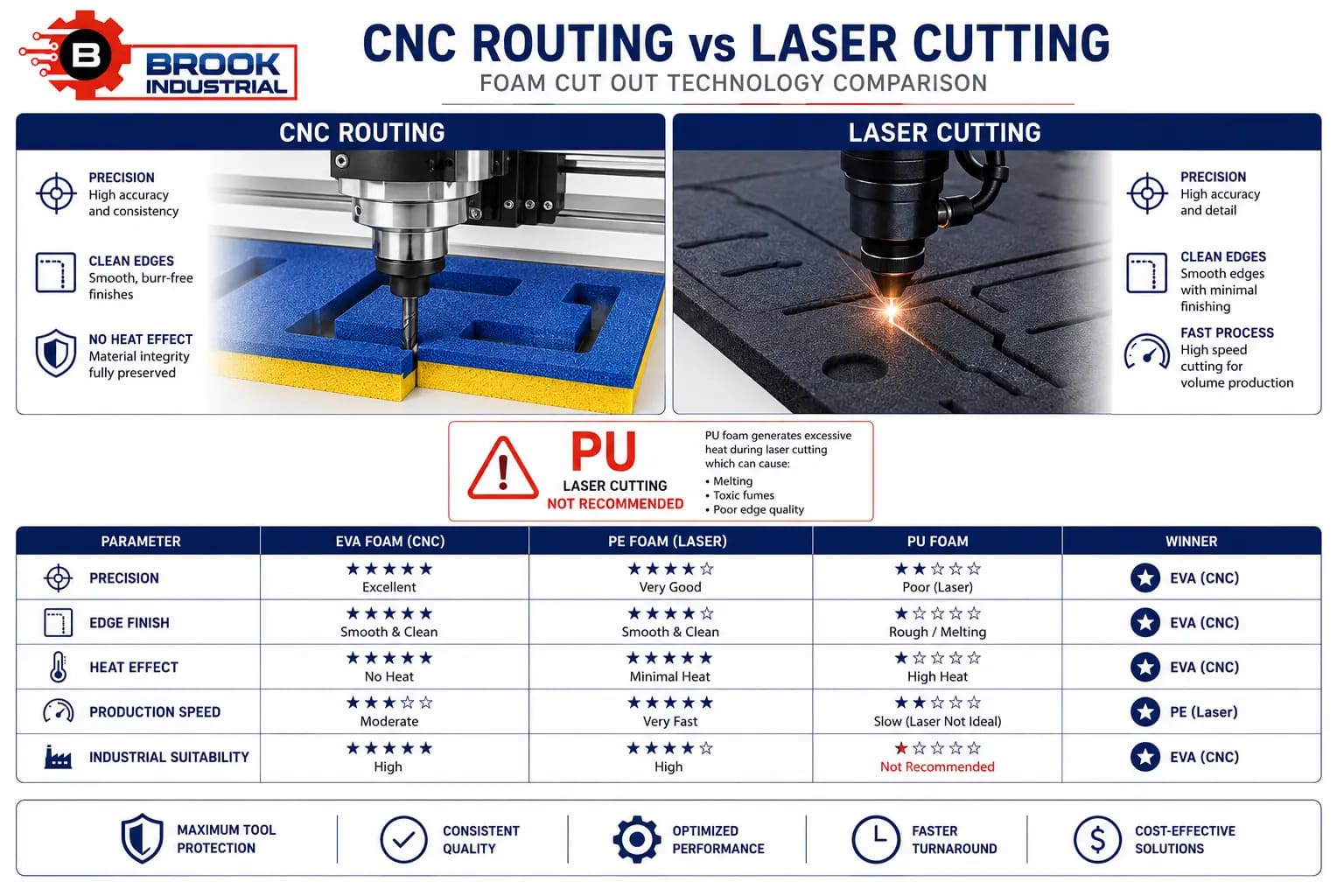
The cutting process is where a foam family’s chemistry actually creates a practical constraint — and it’s a step buyers frequently skip when specifying a system.
- CNC routing works reliably across all four material families (EVA, PE, PU, XLPE) and is the standard method for precision tool-pocket cutting in industrial foam cut outs, because it mechanically removes material rather than relying on melting or vaporizing it.
- Laser cutting works well on EVA and most PE grades, producing clean, sealed edges at speed. It is generally not recommended for PU (polyurethane) foam — cutting PU with a laser or hot wire tends to produce poor edge quality and can release fumes that require proper ventilation and extraction, which is a real workplace-safety consideration your fabricator should manage, not something to attempt in an unventilated on-site setup.
- Hot-wire cutting is a low-cost option sometimes used for simple PE shapes but is unsuitable for PU (toxic fumes) and imprecise for tight-tolerance industrial tool pockets compared to CNC.
- Water-jet cutting is occasionally used for very dense or composite foam-laminate boards but is uncommon for standard tool cut-out fabrication given the cost premium over CNC routing.
Practical takeaway for procurement: if your preferred material is PU, confirm your fabricator is CNC-routing it rather than laser-cutting it, and ask how edge finishing is handled — this is a legitimate technical question, not a nice-to-have, and a fabricator’s answer is a reasonable proxy for how experienced they are with industrial (versus purely decorative/craft) foam work.
Foam cut outs are most effective when integrated into a complete tool control system for visual management and accountability.
EVA Foam Cut Outs — Best for Durability & Precision
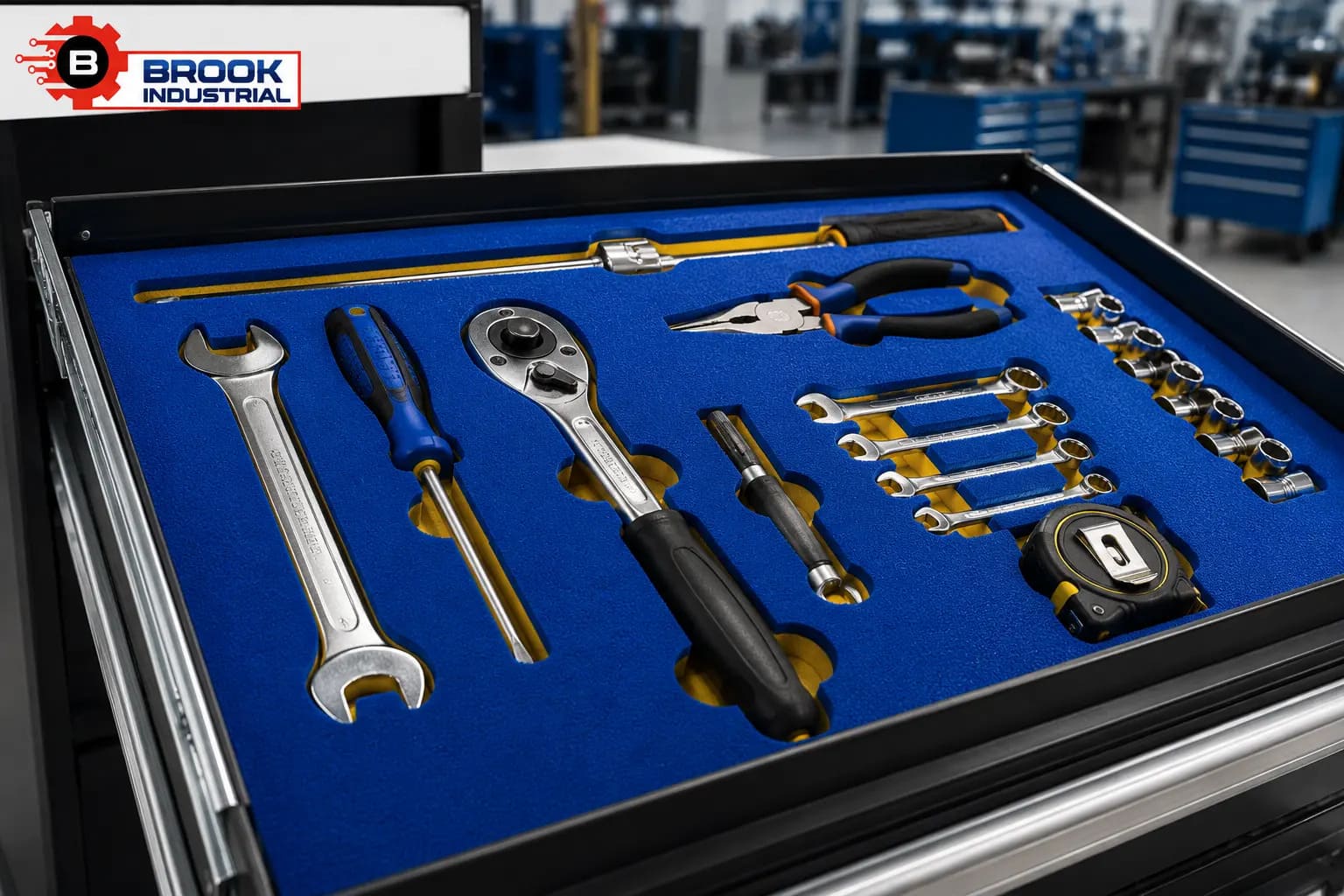
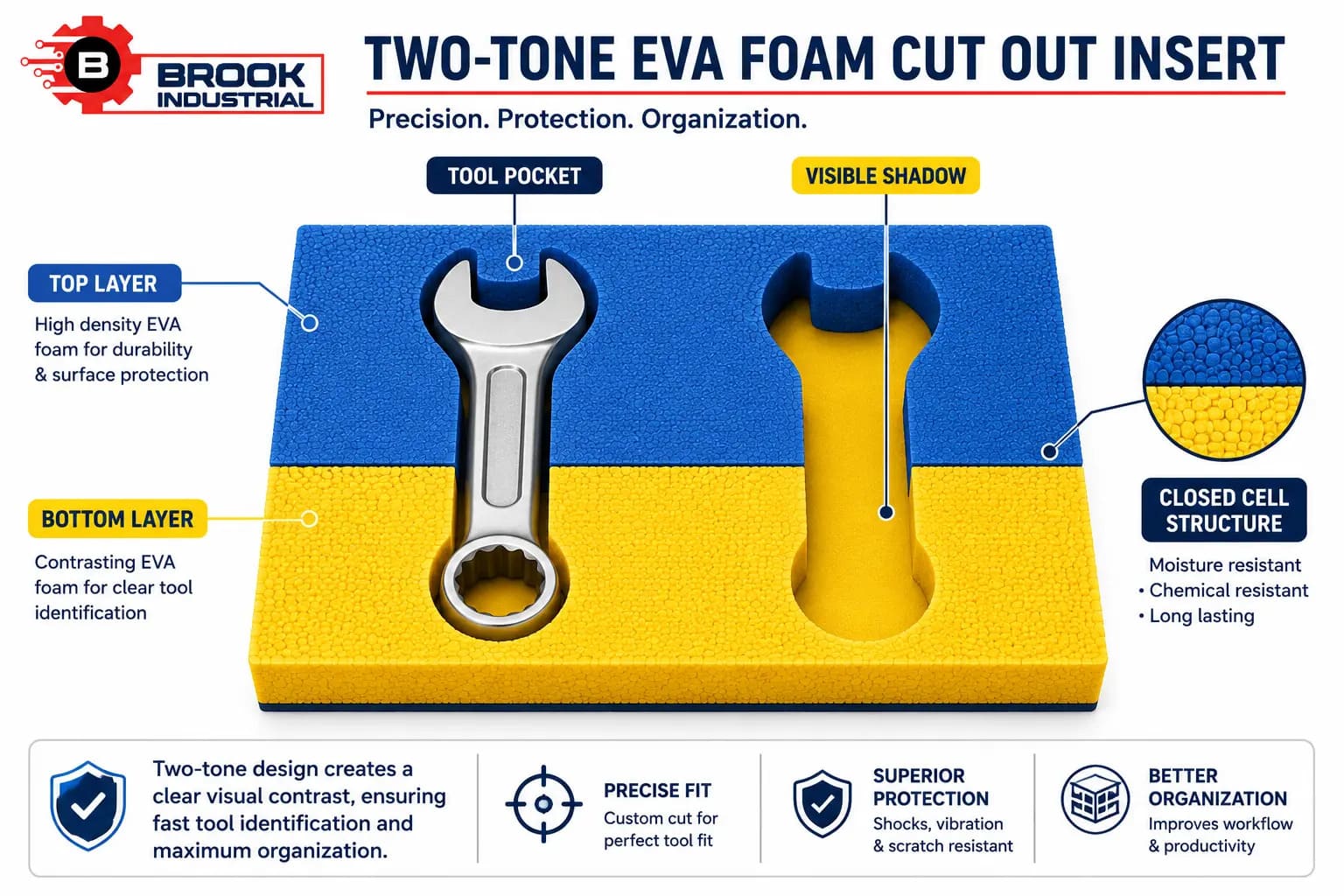
EVA is the closed-cell foam most commonly specified for premium industrial tool control, and for good reason: it has a smooth, dense surface that resists tearing, holds a crisp cut edge, and keeps its shape under repeated tool removal and insertion.
Where EVA foam performs best
- High-frequency-use tool drawers (technicians pulling tools dozens of times a day)
- Facilities running formal 5S tool control programmes or visual-management programs, where a crisp two-tone shadow needs to stay legible for years
- Environments needing moisture resistance — EVA has low water absorption, which matters in humid coastal UAE facilities
EVA foam limitations
- Higher material cost than standard PE
- Requires CNC or laser cutting for clean tool pockets — not a practical DIY material
- Rigid grades can be less forgiving with irregularly shaped or delicate tools than PU
Polyethylene (PE) Foam Cut Outs — Best for Shock Absorption & Cost
Standard polyethylene foam is the most widely used material for general industrial and toolbox foam inserts. It’s available across a density range, which is where most of the performance difference comes from — higher-density PE resists compression and holds sharper tool pockets, while lower-density grades are softer and better suited to cushioning during transport.
Where PE foam performs best
- Standard tool box and tool chest drawer inserts
- Applications prioritizing shock absorption during transport over pocket precision
- Budget-conscious rollouts across many drawers or cabinets, where per-unit cost matters at scale
PE foam limitations
- Aviation and FOD-sensitive environments should be cautious with cut-and-peel PE foam. The layered structure used in some PE cut-and-peel products can shed small foam fragments over time — a foreign object debris risk that matters a great deal in an aircraft maintenance environment, and far less in a general workshop. For aviation maintenance facilities, always follow recognised Foreign Object Debris (FOD) prevention practices recommended by the FAA.
- Lower oil and chemical resistance than PU or XLPE
- Softer grades wear faster under high-frequency, heavy-tool use
Polyurethane (PU) Foam Cut Outs — Best for Delicate & Chemical-Exposed Tools
PU foam’s cushioning quality makes it the better choice when the priority is protecting delicate instruments — calibration equipment, gauges, optical tools — rather than maximizing wear life under constant handling. It also tends to hold up well where tools are periodically exposed to oils, solvents, or harsh cleaning chemicals.
Where PU foam performs best
- Calibration labs and precision instrument storage
- Oil & gas maintenance kits where tools regularly contact hydrocarbons or cleaning solvents
- Lid-side cushioning in hybrid cases (PU lid over an EVA or PE base insert)
PU foam limitations
- Standard PU grades are not inherently anti-static and can be a poor fit for electronics or ESD-sensitive work areas unless a specifically rated anti-static PU is sourced
- Softer PU compresses over time under constant heavy-tool pressure, which can loosen pocket fit faster than EVA or XLPE
Cross-Linked Polyethylene (XLPE) Foam — Best for Heavy-Duty Industrial Use
XLPE is a chemically cross-linked version of standard polyethylene, engineered specifically to close the durability gap between basic PE and premium EVA. The cross-linking process produces a finer, more uniform closed-cell structure, which is why XLPE handles impact, UV exposure, and repeated compression noticeably better than standard PE.
It’s a strong choice for heavy tools, outdoor or semi-outdoor storage (mobile workshops, site containers, mining and construction environments), and facilities that want EVA-like durability at a mid-range price point.
How to Choose the Right Foam by Industry
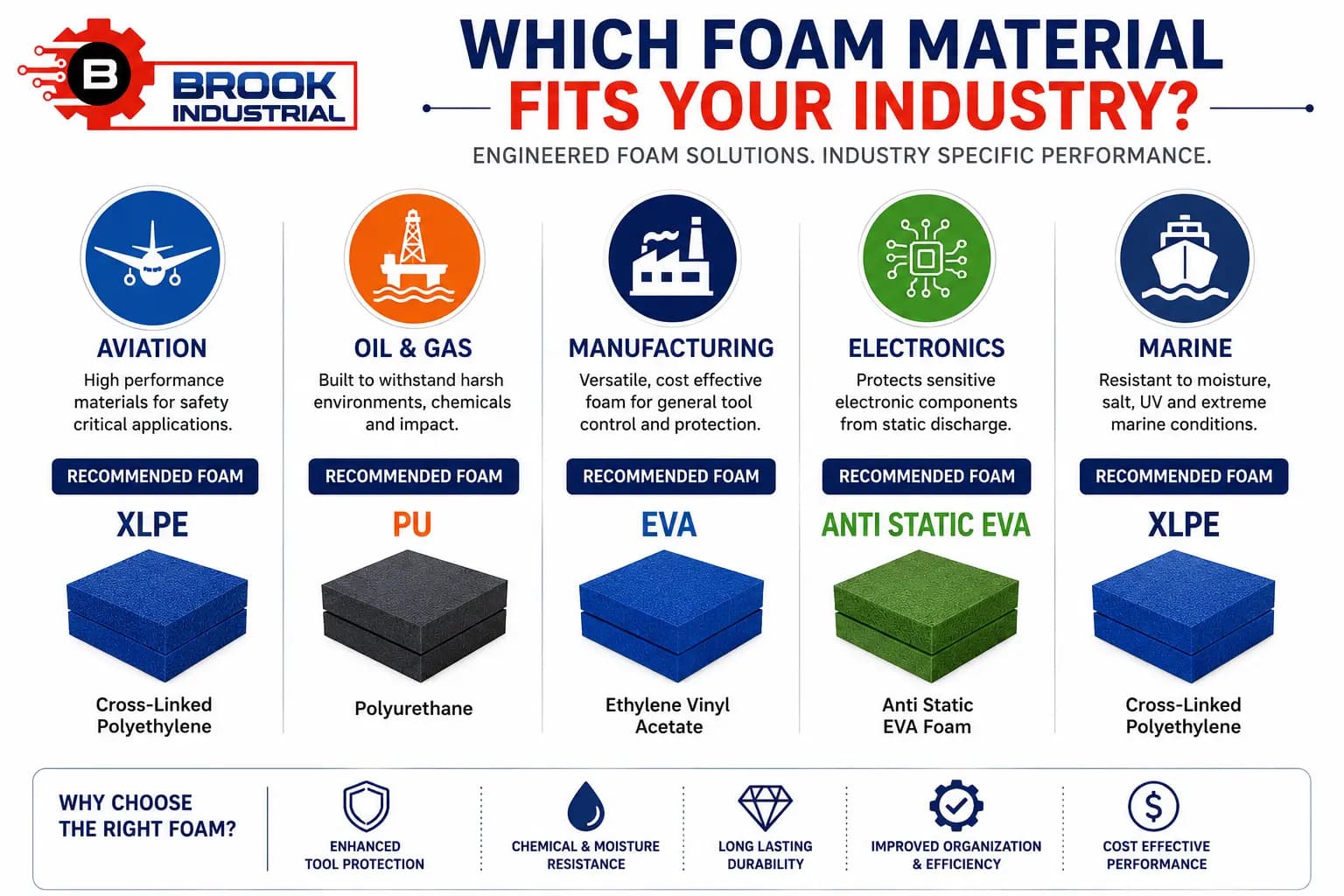
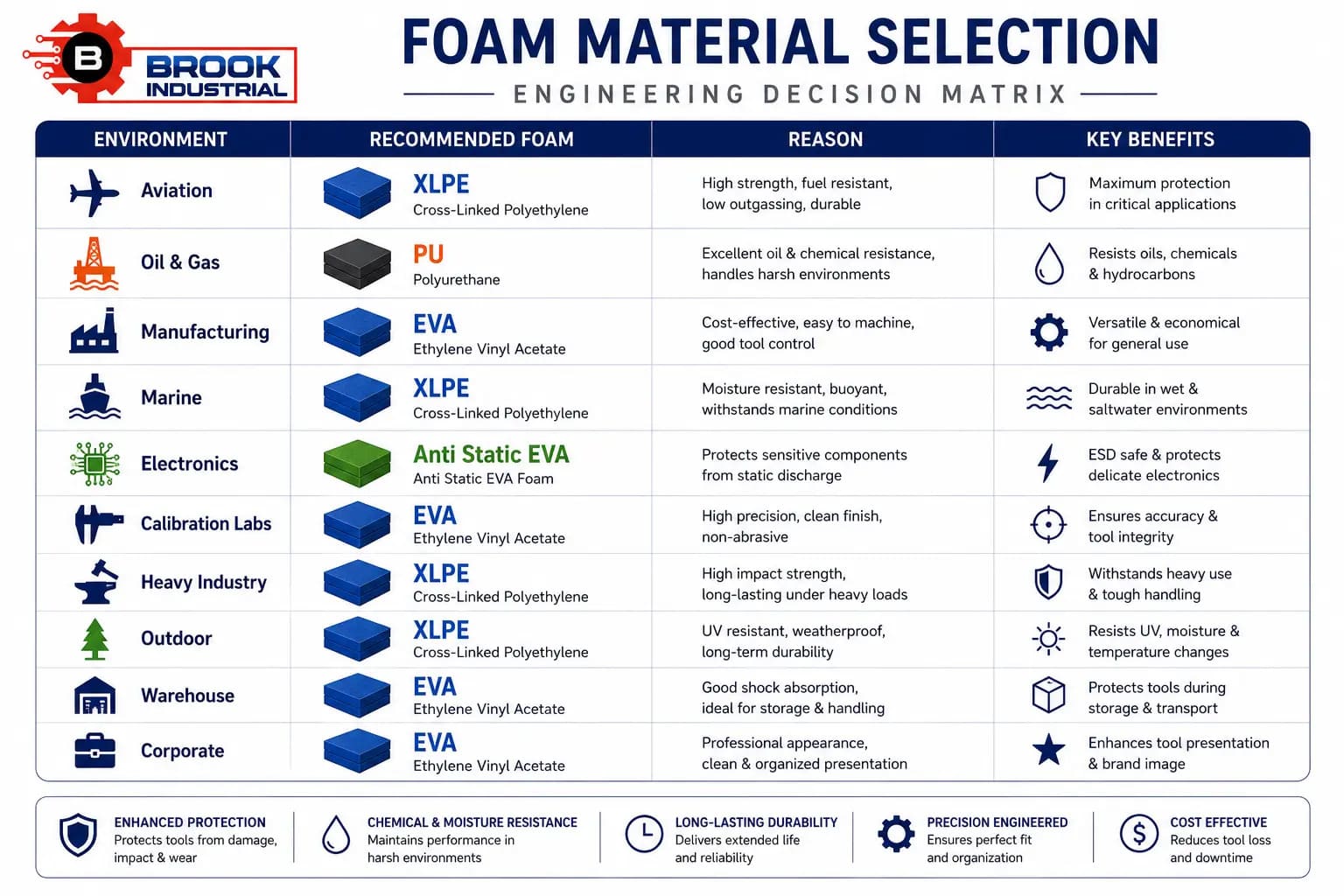
| Industry | Primary Risk to Solve For | Recommended Material |
| Aviation & MRO | Foreign Object Debris (FOD) | EVA or XLPE — avoid cut-and-peel PE for FOD-critical zones |
| Oil & Gas | Chemical/hydrocarbon exposure, UV, heat | PU or XLPE, oil-resistant grade |
| Automotive & Manufacturing | Cost at scale, moderate wear | PE (standard) or EVA for high-traffic lines |
| Electronics & Calibration Labs | Static discharge damage | Anti-static-rated EVA or PU (verify ESD rating, not standard grade) |
| Marine | Moisture, salt-air corrosion of exposed metal tools | EVA or XLPE — closed-cell, low water absorption |
Many industrial facilities also combine foam cut outs with digital tool tracking systems to improve accountability, audit readiness and inventory control across maintenance operations.
This table is a starting point, not a substitute for a site-specific assessment — many facilities run mixed environments (an oil & gas site with an on-site calibration lab, for instance) and benefit from different foam specs in different tool crib zones.
Foam Density, Thickness & Color: The Specs That Actually Matter
Material family is the first decision, but three additional specs determine real-world performance:
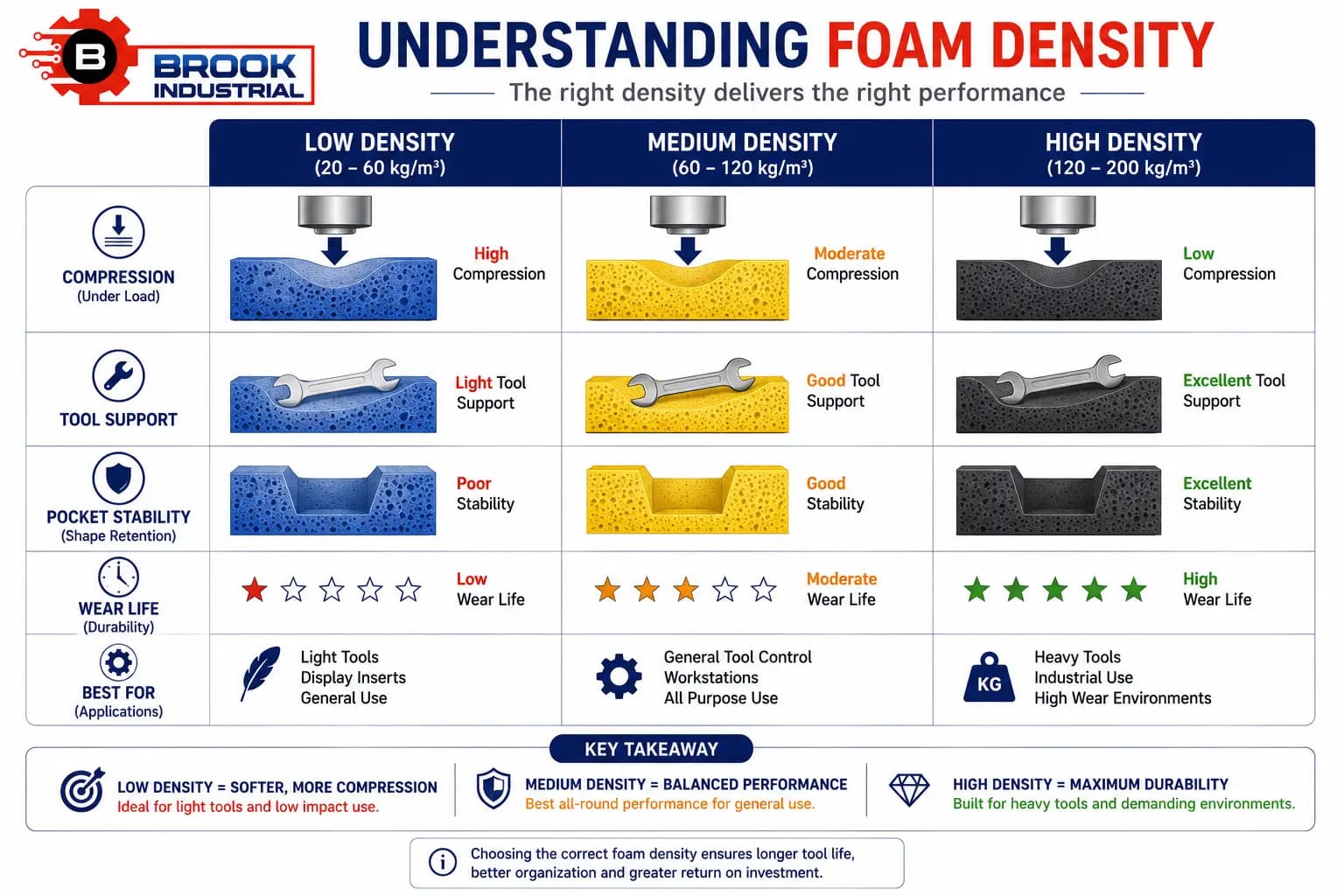
- Density: Higher density holds tool pockets more precisely and resists compression longer, but costs more and is heavier. Most industrial tool cut-outs use medium-to-high density foam; very low density is generally reserved for pure cushioning applications.
- Thickness: Should be matched to the heaviest/tallest tool in the layout, typically with enough base material remaining below the deepest cut pocket to preserve structural integrity — thin residual foam under a deep tool cavity tends to tear.
- Color / two-tone construction: The visual-management value of foam cut out comes from a top layer in one color over a contrasting base layer, so a missing tool shows as a visible colored shadow. This works with EVA, PE, and XLPE; standard PU is harder to produce reliably in two-tone form, which is one more reason PU tends to be used for cushioning layers rather than primary shadow-board inserts.
Mistakes to Avoid When Specifying Foam Cut Out Material
- Choosing on price alone. The cheapest PE insert often has the shortest real-world life in a heavy-use tool crib, making it more expensive over a 3-5 year horizon than a mid-range EVA or XLPE spec.
- Ignoring FOD risk in aviation environments. Not all foam behaves the same under repeated flexing; cut-and-peel layered PE is the specific structure to scrutinize for FOD-critical zones.
- Assuming all foam is anti-static. Standard-grade EVA and PU are not automatically ESD-safe. If tools are used near electronics or PCBs, request a specifically rated anti-static foam.
- Under-specifying thickness for heavy tools. A torque wrench or impact tool needs enough surrounding foam depth to hold its shape after thousands of insertions.
- Treating the material spec as identical across the whole facility. A single facility often has different foam needs in the aviation hangar than in the adjoining calibration room.
Mini Case Study: Getting the Material Choice Wrong in an Oil & Gas Facility
A mid-sized UAE maintenance contractor initially equipped a field tool crib with standard low-density PE foam inserts, prioritizing upfront cost across a large number of drawers. Within roughly eight months, technicians reported that tool pockets in the most frequently used drawers had visibly compressed and lost their precise shape, and that foam exposed to routine oil contact had begun to soften and stain. The facility’s QA team also flagged the layered cut-and-peel structure as a documentation concern during an internal audit, since fragments could theoretically detach in sensitive zones.
The fix was not a redesign of the tool layout — the shadow-board concept and tool arrangement were sound — but a material re-spec to a higher-density, oil-resistant XLPE foam for the highest-traffic drawers, with standard PE retained only in low-frequency, low-exposure storage. The lesson generalizes well beyond this one site: the layout is rarely the problem; the material spec usually is.
Procurement Considerations: What to Ask a Foam Cut Out Supplier
Most foam cut-out procurement conversations stop at “EVA or PE?” That’s not specific enough to actually protect you. Before signing off on a purchase order, a procurement or QA lead should ask the supplier for:
- The specific grade’s data sheet — not a generic material family description. Density, Shore hardness, and compression set at your actual load are the three numbers that matter most.
- Written confirmation of anti-static rating, with the test standard referenced, if any tool in the layout will be used near electronics or ESD-sensitive components. “Anti-static” without a standard reference is a marketing claim, not a spec.
- Fire rating documentation for the specific grade, particularly in facilities with fire-safety audit requirements (aviation hangars, oil & gas sites) — don’t assume a foam family is fire-rated by default.
- Cutting method used (see Manufacturing Methods above) and how tool pockets are finished at the edges, since rough or torn edges accelerate wear at the pocket boundary.
- Lead time and minimum order quantities for re-cuts — tool inventories change, and a facility that can’t get a matching insert re-cut quickly loses much of the operational benefit of the system.
- Sample availability before a full-facility order — a small sample piece under your actual environmental conditions (oil exposure, heat, UV) for a short trial period is a reasonable ask and catches most material-fit problems before a large-scale purchase.
If your facility operates under certified quality systems, verify that your supplier’s documentation and quality processes align with ISO 9001 requirements wherever applicable.
For facilities purchasing complete storage and maintenance solutions, selecting compatible industrial tools alongside custom foam cut outs helps standardize maintenance operations and simplifies future expansion.
Maintenance & Lifespan: Keeping Foam Cut Outs Performing Over Time
Foam cut outs are low-maintenance relative to most tool storage systems, but “low-maintenance” is not “zero-maintenance.” A few practices extend service life meaningfully:
- Wipe down oil or chemical contact promptly rather than letting it sit — even oil-resistant grades perform better with routine cleaning than with prolonged saturation.
- Rotate high-frequency tool positions periodically where the layout allows it, to distribute compression wear rather than concentrating it on the same pockets for years.
- Inspect pocket edges during routine audits, not just tool presence — a tool that technically “fits” a worn, enlarged pocket no longer provides the same instant-visibility benefit the system was installed for.
These routine inspections should also be part of your wider tool accountability programme. Combining scheduled foam inspections with a structured tool control system helps reduce missing tools, improves audit readiness and supports long-term operational safety.
- Re-cut rather than repair when a pocket has visibly deformed; adhesive patches or fillers undermine the visual-management function the whole system depends on.
- Track material performance by zone, not just by facility — if one drawer type consistently underperforms, that’s a signal to re-spec that specific zone’s material rather than replacing the entire facility’s foam on the same schedule.
Foam Cut Out Material Selection Checklist
Before finalizing a foam cut-out order, confirm:
- What is the primary risk in this environment — impact, chemical exposure, static, or moisture?
- Is this zone FOD-critical (aviation, or any environment where foam fragments would be a serious hazard)?
- Does any tool in this layout require anti-static-rated foam?
- Is the foam density appropriate for the heaviest tool and the frequency of use?
- Is the foam thickness sufficient to preserve structural integrity around the deepest cut pocket?
- Does the two-tone color choice provide clear visual contrast under the facility’s actual lighting?
- Has the supplier confirmed the specific foam grade (not just “EVA” or “PU” generically) with a data sheet?
Frequently Asked Questions
What foam is best for tool boxes? For most general industrial tool boxes, medium-to-high density EVA or XLPE foam offers the best balance of durability, precision cut, and cost over the tool box’s working life. Budget PE is a reasonable choice for lower-frequency drawers.
Is EVA foam better than polyurethane for tools? It depends on the priority. EVA generally holds a precise tool pocket shape longer under frequent use and resists moisture well. Polyurethane offers superior cushioning for delicate instruments and often better chemical resistance, but standard-grade PU is not typically anti-static and can compress faster under constant heavy-tool pressure.
What foam is anti-static for tool storage? Anti-static, or ESD-safe, foam is a specifically rated grade of EVA or PU manufactured with conductive or dissipative additives — it is not a property of standard-grade foam by default. Always request a data sheet confirming ESD rating for electronics or calibration environments.
What foam is oil-resistant for industrial tool inserts? Polyurethane and cross-linked polyethylene (XLPE) generally offer stronger resistance to oils, fuels, and common cleaning solvents than standard polyethylene or EVA, making them the more common specification for oil & gas and heavy maintenance environments.
How thick should foam cut out be for tools? There’s no single universal thickness — it should be set by the height and weight of the heaviest tool in the layout, with enough foam remaining beneath the deepest cut pocket (commonly a minimum residual base layer) to prevent tearing. A supplier reviewing your actual tool inventory can specify this accurately.
Get the Right Foam Cut Out Material for Your Facility
The wrong foam material doesn’t just wear out faster — it can quietly undermine the safety and compliance case your tool control system was supposed to support. Brook Industrial Tools works with aviation, oil & gas, marine, and manufacturing facilities across the UAE to specify foam cut-out systems by actual site risk, not by catalog default.
Request a Foam Cut Out Material Assessment →
Contact Brook Industrial Tools:
- Phone: +971 4 8866104
- Email: info@brookindustrialtools.com
- Location: 215, Umm Ramoul, Shed 2, Dubai, UAE